The Future of Consulting Jobs and the Traditional Pyramid
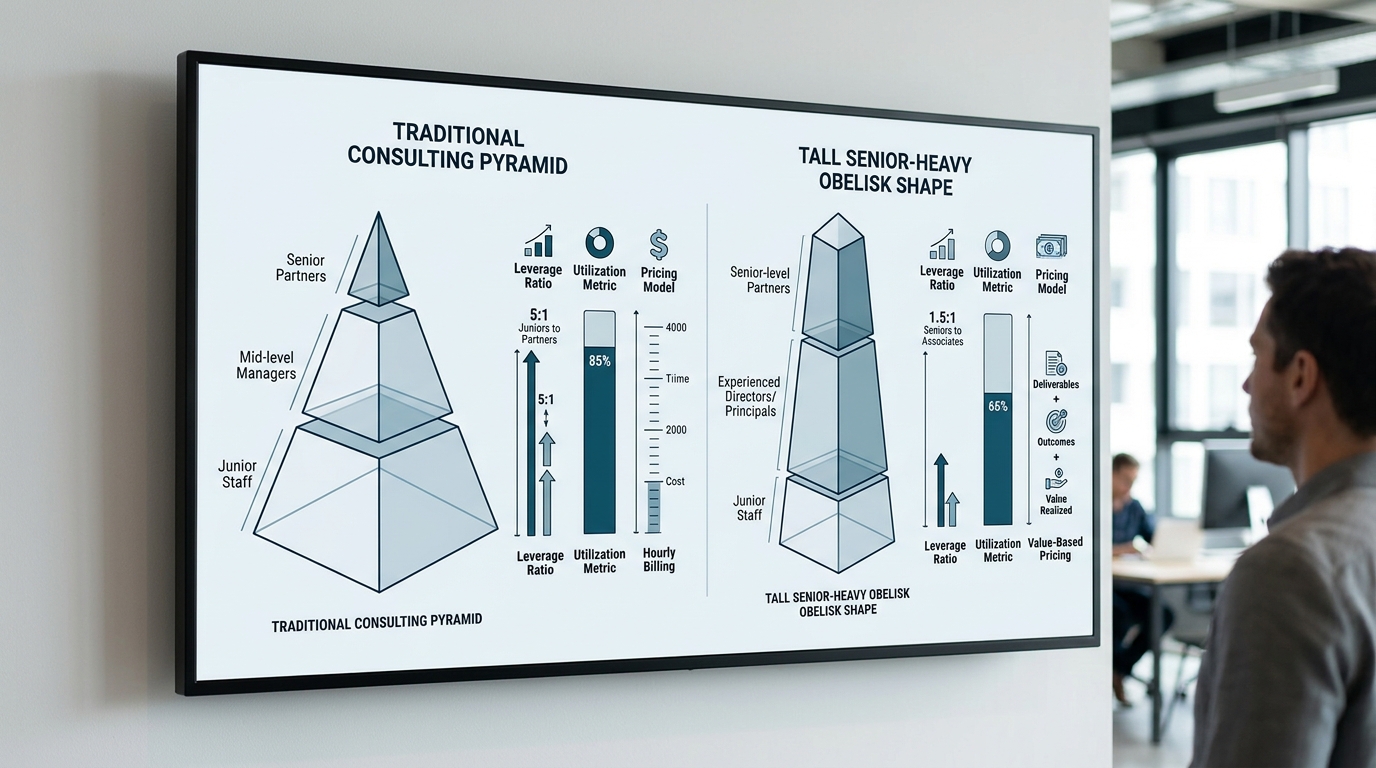
The future of consulting jobs is shifting from high-volume manual analysis to high-leverage strategic judgment as artificial intelligence automates entry-level research, data synthesis, and deck creation. Traditionally, management consulting relied on a pyramid model with a broad base of junior analysts supporting a small number of partners. Generative AI tools now perform routine analytical tasks in minutes, collapsing the bottom of the pyramid and forcing firms to operate with smaller, highly leveraged teams. The primary challenge facing advisory firms is no longer how to synthesize data quickly, but how to develop partner-level judgment when the entry-level apprenticeship work that historically built that experience is automated.
For decades, the economics of strategy consulting depended on leverage ratios. Senior partners sold large engagements that required armies of junior consultants to conduct market research, clean financial datasets, build valuation models, and construct presentation slides. This structural dynamic served a dual purpose: it generated substantial billable hours while acting as a rigorous training ground. Junior consultants developed domain expertise and analytical intuition by spending thousands of hours manually processing business context.
Artificial intelligence fundamentally alters this apprenticeship pipeline. Harvard Business Review's assessment is that consulting is not disappearing but being fundamentally reshaped. Practitioners describe the same direction of travel: the pyramid shrinks at the bottom half as AI absorbs work once handled by junior consultants, pushing firms toward a more senior-expert-heavy model, while the Big Four accounting firms are already cutting back on entry-level roles. Firms therefore need new mechanisms to cultivate critical thinking, problem framing, and client leadership without relying on repetitive manual labour.
| Dimension | Traditional Consulting Pyramid | AI-Era Advisory Model |
|---|---|---|
| Organizational Structure | Broad junior base supporting managers and partners | Lean, senior-expert team augmented by AI agents |
| Junior Work Focus | Manual data collection, research synthesis, slide drafting | AI orchestration, source verification, scope framing |
| Leverage Source | Billable analyst hours and headcount volume | AI capability leverage and domain expertise |
| Apprenticeship Model | Learning through repetitive manual data processing | Learning through supervised scenario design and prompt logic |
Why Junior Analyst Automation Matters Now
The rapid evolution of generative AI tools and specialized deck generation software has coincided with intense client pressure on consulting fee structures. Corporate buyers increasingly resist paying premium hourly rates for basic desktop research or generic industry overviews that internal strategy teams can generate using enterprise AI tools. As clients demand outcome-based pricing and faster delivery cycles, consulting firms are compelled to automate low-margin junior work to preserve operational margins.
Macroeconomic studies confirm that entry-level analytical roles face the earliest structural exposure to AI automation. Analysis by Boston Consulting Group indicates that roughly 12 percent of workforce roles are divergent, meaning entry-level and junior positions face early automation of routine structured tasks while senior oversight and judgment responsibilities expand. Major advisory firms are already using proprietary models to absorb this work: McKinsey's internal platform Lilli, used every month by more than 75 percent of the firm's 43,000 employees, drafts PowerPoint decks and client proposals that were traditionally assigned to junior staff, while BCG consultants refine presentations with a tool called Deckster.
This structural shift changes the standard strategy consulting process across every engagement phase. When preliminary research, market scans, and qualitative summaries take minutes rather than weeks, project timelines shrink dramatically. However, this acceleration amplifies the risk of AI hallucinations and surface-level analysis if junior consultants lack the training to rigorously validate machine outputs against primary sources.
- Client demand for outcome-based fee structures over traditional time-and-materials billing
- Rapid adoption of enterprise AI deck tools and automated research synthesis engines
- Shrinking margins on standard entry-level research and market mapping engagements
- Widening gap between raw AI output generation and defensible board-level strategic insight
The Impact on Entry-Level Hiring and Firm Economics
As major consultancies reduce entry-level analyst intakes, the entry bar for junior candidates is rising. Firms no longer evaluate candidates solely on financial modeling speed or presentation formatting. Instead, consultancies seek junior professionals who possess strong problem framing abilities, digital system fluency, and the capacity to critique AI-generated hypotheses from day one.
The Future-Consultant Skill Framework
To thrive in an AI-accelerated consulting environment, junior professionals must transition from manual data processors to strategic orchestrators. The Future-Consultant Skill Framework outlines six core competencies required for modern strategy advisory. This framework shifts training focus away from rote presentation assembly toward higher-order strategic reasoning and human judgment.
In an ecosystem where generative models can produce plausible market analysis instantly, human value centres on asking the right questions and verifying underlying assumptions. Modern advisory professionals must master AI strategy consulting workflows that combine technical automation with rigorous oversight. Industry commentators dividing the non-automatable work into AI facilitators, engagement architects and client leaders place human judgment on AI-generated findings at the centre of that middle tier. Without that structured evaluation, automated recommendations risk compounding strategic errors across client organizations.
| Skill Pillar | Legacy Expectation | AI-Era Requirement |
|---|---|---|
| Problem and Scope Framing | Executing pre-defined research briefs | Structuring complex strategic ambiguities into testable hypotheses |
| Critical Thinking & Verification | Summarizing secondary market reports | Auditing AI outputs against primary sources and empirical facts |
| Domain Expertise | Memorizing industry benchmarks | Applying nuanced sector context to evaluate strategic options |
| Stakeholder Management | Preparing interview notes | Navigating organizational dynamics and building leadership consensus |
| AI Orchestration | Manual data entry and search queries | Designing structured AI workflows and agent instructions |
| Decision Communication | Formatting complex slide decks | Synthesizing complex trade-offs into board-ready executive narratives |
Reinventing the Consulting Apprenticeship
Developing executive judgment without traditional manual grunt work requires deliberate firm-level intervention. Forward-thinking advisory practices are embedding junior consultants directly into high-stakes client discussions alongside senior partners. By observing real-time negotiation, trade-off evaluation, and executive alignment, junior staff absorb strategic intuition faster than they would through isolated spreadsheet auditing.
Practical Decision Questions for Strategy Buyers
Corporate executives, board members, and strategy buyers must adapt their procurement practices when evaluating external advisory proposals. Traditional consulting proposals often obscure team leverage and AI usage behind blended hourly rates. Pressure on that model is already visible in how engagements are priced, with reporting noting that a quarter of McKinsey's fees now come from outcome-based pricing. Buyers should therefore ask direct, structured questions to ensure they pay for genuine senior expertise rather than automated junior labour.
Evaluating consulting proposals through an evidence-led lens requires clarity on how firms integrate automation into their delivery pipeline. Incorporating a structured executive decision-making framework during partner selection prevents organizations from overpaying for commodity research while ensuring that critical trade-offs receive dedicated senior attention.
- Workflow Integration: How exactly is generative AI integrated into your research, modeling, and deck generation pipeline?
- Pricing Structure: Are engagement fees based on traditional billable analyst hours or outcome-based deliverables reflecting AI leverage?
- Source Auditability: Can your firm provide full source traceability for every strategic claim, benchmark, and financial figure in the final deck?
- Senior Oversight: What explicit validation loops ensure senior partners review and stress-test AI-generated market hypotheses?
- Team Composition: Does the proposed team reflect a traditional junior-heavy pyramid or a lean, senior-expert squad?
- Capability Transfer: Will the engagement embed repeatable AI decision workflows and frameworks into our internal strategy team?
Evidence Checklist and Adoption Red Flags
When assessing an external advisory firm or internal strategy team's AI maturity, enterprise leaders must evaluate technical rigor and governance standards. According to research by LexisNexis, 72 percent of management consultants report high confidence in AI usage, yet 54 percent admit to using unapproved AI tools for client work, and 62 percent of firms are deploying AI agents. This widespread ungoverned adoption underscores the urgent need for verifiable human validation loops and auditable platforms.
Organizations must establish clear criteria to distinguish mature, evidence-traceable consulting practices from superficial AI adoption. Requiring auditable strategy decks with verifiable footnotes protects enterprise decision-makers from relying on halluncinated industry data or fabricated market sizes.
| Assessment Category | Adoption Red Flags | Verified Hybrid Workflows |
|---|---|---|
| Source Verification | Citing unverified AI summaries or memory-based figures | Every metric linked to verified primary sources and filings |
| Workflow Governance | Shadow AI usage with unapproved personal tools | Governed, enterprise-grade AI platforms with audit logs |
| Deliverable Quality | Generic, buzzword-heavy decks with superficial logic | Structured MECE issue trees and evidence-backed trade-offs |
| Quality Control | Direct presentation of raw generative outputs to clients | Mandatory multi-stage human domain expert review loops |
| Data Security | Uploading sensitive client assets into public models | Private enterprise deployment with strict data isolation |
How to use this in your next workflow
Corporate strategy leads, transformation directors, and internal operators do not need to wait for external consultancies to modernize their analytical practices. Internal teams can adopt hybrid technology and consulting workflows today to accelerate market research, competitive benchmarking, and strategic planning while maintaining strict analytical rigor.
To implement these modern workflows effectively, operators should follow a structured four-stage process that embeds the Future-Consultant skills into internal team routines. Grounding internal projects in a proven transformation strategy framework ensures that rapid AI synthesis translates directly into actionable enterprise roadmaps.
- Define Explicit Problem Boundaries: Begin every strategy initiative by structuring ambiguous executive questions into MECE issue trees before initiating research.
- Configure Governed Research Workflows: Utilize specialized enterprise AI engines to ingest validated internal filings, market research, and expert transcripts.
- Mandate Full Source Traceability: Require team members to audit every AI-generated claim against primary documentation, stripping any unverified metrics.
- Focus Human Energy on Decision Alignment: Redirect time saved on manual deck formatting toward executive workshops, scenario planning, and stakeholder alignment.
How Decisity supports the workflow
Decisity is an AI-native strategy platform developed by CITO GmbH for strategy teams, executive leaders, and corporate advisors. Rather than replacing human judgment or making autonomous business decisions, the platform provides a structured digital environment that combines automated analytical speed with rigorous source auditability.
The platform transforms how teams conduct research, problem framing, and strategic options analysis. By turning raw documents, market datasets, and client briefs into MECE-structured frameworks, it accelerates early-stage analysis while ensuring every strategic insight maintains complete lineage back to primary sources. Strategy teams leveraging AI-native strategy consulting workflows can reduce manual deck assembly time while increasing analytical precision.
- Structured Strategic Reasoning: Guides strategy teams from ambiguous executive queries to clear, logical hypothesis trees.
- Scope and Problem Framing: Helps leaders define exact strategic boundaries and decision criteria before allocating capital.
- Evidence-Traceable Analysis: Connects every strategic assertion, market size estimate, and competitive benchmark to verifiable primary sources.
- Decision Workflows and Roadmaps: Streamlines cross-functional review loops to convert analytical findings into actionable strategy execution plans.
- Board-Ready Deliverables: Generates structured with action titles and verifiable footnote citations.
By providing a transparent, evidence-led infrastructure, this kind of platform helps internal strategy departments and advisory practices operate with high leverage, elevating junior analysts into strategic orchestrators and focusing senior leadership on decision quality.