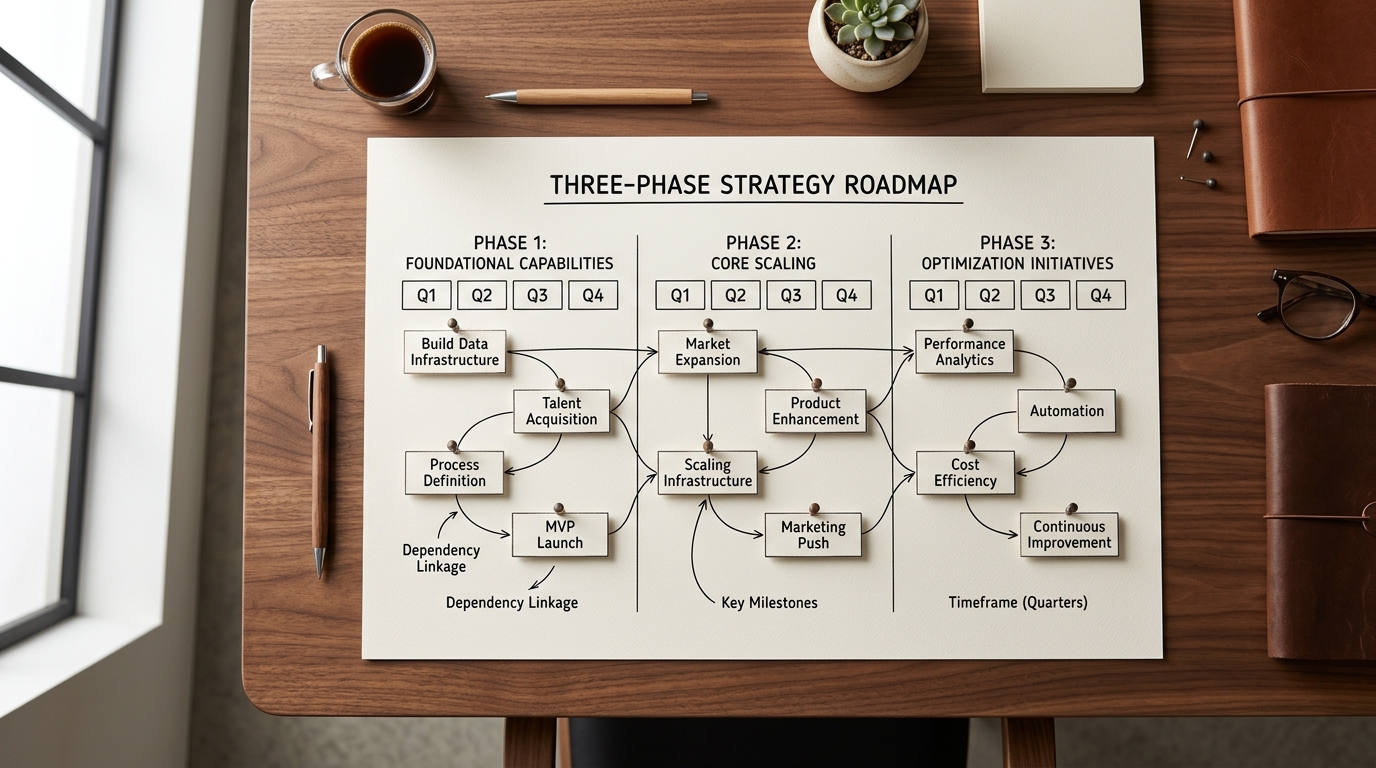
Bridging the Strategy-to-Execution Gap
Strategic ambitions frequently fail at the point of execution. According to research by McKinsey, even high-performing companies face an average 30 percent strategy-to-performance gap due to structural and operational disconnects. Senior leadership teams often spend months refining market positioning, yet fail to adjust the operational machinery required to realize that value. Instead of systematically aligning resources and decision rights, leadership often falls into the trap of simply reshuffling org chart boxes without altering underlying operational behaviors.
Translating Strategic Intent into Target Capabilities
An effective target operating model (TOM) bridges this gap by converting high-level strategic intent into concrete organizational capabilities. Rather than viewing structure as a static organizational chart, a modern TOM establishes clear operational links across three core pillars:
- Structure and spans: Defining reporting lines, accountability boundaries, and organizational interfaces that reflect strategic priorities rather than historical legacy.
- Processes and cadence: Establishing cross-functional workflows, operational SLAs, and performance management rhythms that drive rapid value creation.
- Governance and decision rights: Clarifying explicit decision authority to eliminate operational bottlenecks and enforce governance across change programs.
By structuring these capabilities with rigour and auditability, executives ensure that strategic goals translate into disciplined operational execution during organization transformation programs.
Defining Design Principles Before Structure
Jumping directly into box-and-line reporting charts is one of the most common failure modes in enterprise restructuring. Before drawing new governance structures, executive teams must ground every organizational choice in explicit design principles. Bain & Company research highlights that establishing between 7 and 15 strategic design principles creates an objective evaluation framework before detailed structural work begins. These principles translate overarching corporate ambition into concrete operating criteria.
Anchoring Value Drivers and Defining Operational Boundaries
Design principles function as non-negotiable guardrails that connect strategy directly to execution. Instead of reorganizing around isolated management preferences, structured principles define precisely where value is generated, how corporate scale should be leveraged, and which capabilities require dedicated focus. For executive teams managing an organization transformation program, agreeing on design principles early prevents premature restructuring and protects primary value drivers from organizational disruption.
- Value creation focus: Pinpoints the specific capabilities, customer channels, and product lines that generate competitive advantage, directing resource allocation accordingly.
- Decision authority: Clarifies which strategic and operational decisions belong to local business units and which require centralized oversight.
- Center vs. business unit scope: Establishes explicit boundaries for corporate overhead and shared service centers to eliminate unnecessary complexity.
- Preservation and change priorities: Identifies current organizational strengths to protect alongside specific operational bottlenecks that must be dismantled.
By codifying 7 to 15 design principles prior to drawing formal reporting lines, C-level executives and transformation offices establish an objective, auditable standard. Every proposed reporting structure, committee structure, and resource shift can then be evaluated transparently against whether it upholds or undermines these strategic principles.
Designing Structure and Governance Around Value
Traditional organizational charts map reporting lines rather than value streams, frequently creating structural friction and misaligned incentives. To translate strategy into execution, executive leadership must align business units and shared services directly to primary sources of value creation. Research shows that 71% of CEOs believe legacy operating models are not fit for the age of AI, while only 24% of CIOs feel their current structures effectively adapt to business needs. A modern target operating model restructures these boundaries so that resource allocation, management focus, and capital deployment support the core value-creation plans.
Eliminating Friction and Redundant Layers
Preventing cross-functional friction requires establishing transparent boundaries between commercial business units and centralized shared services. When central functions behave as bureaucratic bottlenecks rather than internal service platforms, business units often build shadow capabilities that inflate overhead costs. A value-led operating design enforces clear service-level agreements and lean governance, ensuring shared capabilities enable rapid execution across business units while maintaining corporate discipline.
- Primary Value Alignment: Structure front-line business units around key customer segments and direct revenue drivers.
- Platform Shared Services: Reframe support functions into modular internal service hubs to optimize resource allocation across divisions.
- Deliberate De-layering: Remove redundant management tiers to shorten decision pathways and reduce administrative overhead.
By grounding structural decisions in evidence-based analysis rather than static hierarchy charts, transformation offices and executive leadership protect the financial baseline while positioning the enterprise for scalable growth.
Establishing Clear Decision Rights with RAPID
Consensus-driven governance frequently stalls critical execution timelines across major corporate restructuring initiatives. When decision rights remain ambiguous, leadership teams default to committee consensus, repeated re-litigation, and delayed resource allocation. Establishing explicit decision accountabilities accelerates execution velocity while safeguarding the core financial baselines established in portfolio value-creation plans.
To eliminate governance bottlenecks and role confusion, Bain & Company developed the RAPID framework to assign single-point accountability across complex organizational structures. RAPID establishes operational discipline by delineating five distinct decision roles:
- Recommend (R): A single initiative owner gathers market and internal evidence, structures actionable options, and drives the proposal forward.
- Agree (A): Key stakeholders who must sign off on specific regulatory, legal, or financial compliance aspects; restricted strictly to mandatory gatekeepers.
- Perform (P): Operational leaders responsible for downstream implementation, engaged during option formulation to ensure real-world feasibility.
- Input (I): Subject-matter experts who provide critical functional data and technical analysis but hold no voting or veto authority.
- Decide (D): Exactly one designated leader who holds ultimate authority to select the path forward and commit corporate resources.
Replacing consensus-driven decision-making with single-point accountability fundamentally improves organizational agility. Assigning a single 'D' prevents structural paralysis, reduces approval latency from months to days, and ensures that executive decisions translate into measurable operational outcomes across modern organization transformation programs.
Executing Transformation Through a High-Impact PMO
Target operating models frequently fail during implementation due to fragmented governance and uncoordinated workstreams. Research from the Project Management Institute indicates that 35% of senior executives view the disconnect between strategic planning and execution as their primary barrier to business reinvention, with only 50% of transformation projects successfully delivering their intended strategic value. A modern Transformation Management Office (PMO) bridges this gap by functioning as an active value-orchestration hub rather than a passive status-reporting function. For corporate executive teams and mid-market managing directors, an empowered PMO translates top-down strategic imperatives into structured, traceable work packages with explicit ownership and measurable target outcomes.
Core Capabilities of an Execution-Focused Transformation PMO
- Strategic Portfolio Alignment: Continuously auditing active transformation initiatives against target operating model objectives to eliminate misaligned projects.
- Cross-Functional Dependency Mapping: Identifying critical path bottlenecks across organizational units, IT architectures, and regulatory constraints before delivery delays occur.
- Traceable Value Tracking: Enforcing empirical baseline measurement and milestone reporting, ensuring every cost savings or revenue lever remains verifiable.
- Dynamic Capital and Talent Allocation: Reallocating scarce technical and operational resources to high-impact workstreams based on live performance data.
To prevent value leakage across complex implementation cycles, steering committees require direct visibility into operational progress and milestone friction. Structured oversight in large-scale organization and transformation initiatives replaces subjective status summaries with evidence-backed performance metrics. By grounding governance in objective baseline data and explicit decision rights, the PMO ensures that target operating model structures translate directly into sustained operational performance.
Protecting the Value Case and Preventing Value Leakage
Organizational transformations frequently falter in the gap between executive strategy and front-line execution. Empirical research demonstrates that 70% of major organizational transformations fail to deliver their planned objectives, leaving a substantial portion of strategic value uncaptured. Value leakage typically occurs when target operating model design principles are decoupled from financial baselines, allowing initial cost efficiencies to dissolve and headcount reductions to revert as restructuring progresses.
Essential PMO Mechanisms for Benefit Realization
- Auditable financial baselines: Establishing baseline productivity metrics and operating costs prior to changing reporting lines or reallocating decision rights.
- Dynamic milestone tracking: Tying operational milestones directly to financial benefit realization curves rather than treating progress as a binary implementation checklist.
- Evidence-led reporting: Replacing subjective status updates with source-traceable metrics that connect team-level outputs directly to top-line and bottom-line targets.
Mitigating Common Value Leakage Drivers
| Leakage Driver | Operational Root Cause | Governance Safeguard |
|---|---|---|
| Erosion of decision velocity | Unclear accountability and overlapping decision rights | Formal RACI matrix aligned to target operating model |
| Cost re-inflation | Unmonitored headcount additions in non-core units | Auditable FTE baselines and centralized headcount approvals |
| Delayed synergy realization | Disconnected PMO tracking across business units | Integrated milestone schedules tied directly to financial benefit realization |
Sustaining board-level accountability requires a dedicated transformation office capable of tracking leading operational indicators alongside trailing EBITDA impact. Connecting structural organizational changes directly to enterprise value-creation plans enables executive teams and private equity sponsors to identify operational friction before it erodes targeted returns. Governance grounded in source-traceable progress reports ensures that initial financial targets remain defensible throughout the implementation lifecycle.
Ensuring Auditability and Evidence-Led Governance
Operating model redesigns frequently founder during implementation when strategic choices lack a transparent, verifiable link to operational realities. Without verifiable baselines, even well-planned transformations often fail to achieve highly successful outcomes. When corporate restructurings, post-merger integrations, or portfolio value-creation plans face board review, directors and private equity sponsors rightly reject broad assertions that rely on unverified estimates. Establishing evidence-led governance requires auditable strategy decks where every headcount adjustment, cost synergy, and operational benchmark is explicitly linked to primary source files.
Disciplines of Evidence-Led Governance
| Governance Dimension | Traditional Approach | Evidence-Led Governance |
|---|---|---|
| Problem Structuring | Ad-hoc functional siloing with overlapping responsibilities | MECE decomposition of cost pools, decision rights, and workflows |
| Executive Synthesis | Verbose reports with descriptive background slides | Pyramid-structured decks with governing action titles on every slide |
| Source Auditability | Unverifiable static spreadsheet models and manual decks | Clickable line-item traceability from target metrics to raw source documents |
| Sponsor Defense | Subjective negotiations during stage-gate reviews | Fact-based alignment that survives rigorous board and IC scrutiny |
Embedding full auditability into organization and transformation programs enables CEOs, CHROs, and PMO leads to protect the value case through every stage-gate review. By providing complete transparency into the evidence behind every decision, leadership teams can make tough trade-offs, address execution risks proactively, and withstand board scrutiny with total confidence.