Why a Defensible Strategic Planning Process Matters
To convert corporate ambition into a defensible operational roadmap, leadership teams must establish a structured strategic planning process that separates strategic debate from annual financial budgeting, grounds core assumptions in external market evidence, and locks in clear resource allocation milestones. The strategic planning process is defined as the systematic governance cadence through which an enterprise evaluates its competitive environment, selects high-conviction growth vectors, allocates capital, and aligns organizational capabilities behind measurable strategic initiatives. Without this structured foundation, strategic planning devolves into a passive annual exercise where financial targets are padded and strategic initiatives fail to guide daily operational trade-offs.
For heads of strategy, corporate development leads, and chief executives, the cost of ungrounded planning is substantial. When Bain & Company asked nearly 300 global executives to rate their company's planning process, only one in three said the strategy it produced met three vital criteria: bold ambition, adaptability in the face of changing market conditions, and concrete guidance for management and the front line. When strategic planning becomes a bureaucratic exercise focused on updating spreadsheet models rather than testing core strategic hypotheses, organizations face severe capital misallocation, delayed market entry, and persistent friction between executive leadership and operational business units.
Moving Beyond Bureaucratic Exercises to Defensible Strategy
Traditional corporate planning often defaults to incremental budgeting, taking last year's performance and adding minor margin adjustments. A defensible strategic planning process disrupts this inertia by forcing explicit trade-offs. Rather than attempting to fund every internal project, leadership teams evaluate strategic initiatives against rigorous market benchmarks, competitive intensity, and organizational execution capacity.
- Bold Ambition: Defining clear market expansion targets that extend beyond baseline performance trends.
- Market Adaptability: Incorporating scenario planning to adjust capital allocation as macroeconomic conditions evolve.
- Concrete Guidance: Translating high-level board aspirations into unambiguous workstreams and operational decision rights.
By replacing subjective consensus with evidence-led analysis, strategy teams establish credibility with boards and investors. A defensible plan creates a clear line of sight from board-level goals to ground-level execution, ensuring that every strategic choice is backed by verifiable market data.
A Practical Framework for Strategic Planning
A high-performing strategic planning process requires a modular, multi-phase framework that prevents financial forecasting from crowding out strategic analysis. Empirical research demonstrates that separating strategic debate from annual budgeting improves overall strategy quality by up to 40%. By structuring the cycle into distinct phases, organizations preserve space for rigorous market evaluation before committing to financial targets.
Phase 1: Ambition Setting and Problem Framing
The planning cycle begins by establishing executive ambition and framing the central strategic challenges facing the business. Strategy teams utilize MECE problem structuring to break complex growth targets into mutually exclusive, collectively exhaustive sub-issues. This structured problem framing prevents teams from confusing symptoms, such as slowing top-line growth, with root causes, such as changing customer preferences or cost structure inefficiencies.
Phase 2: Strategic Option Generation and Evaluation
Once the problem space is structured, teams generate distinct strategic options rather than converging immediately on a single path. Each option represents a distinct combination of market focus, competitive positioning, and capital commitment. Evaluated against rigorous scenario models, these options highlight key risks, required capabilities, and expected returns under varying market dynamics.
Phase 3: Budget Linkage and Roadmap Sequencing
Only after the strategic direction is locked do teams bridge strategy into the financial budget. Capital allocation decisions follow strategic choices, ensuring that high-conviction growth initiatives receive dedicated funding rather than prorated budget splits across existing business units.
| Framework Phase | Primary Objective | Core Governance Deliverable | Typical Cadence |
|---|---|---|---|
| Phase 1: Problem Framing | Structure core strategic challenges MECE and set bold executive ambition | Strategic Scoping Brief & Problem Tree | Q1 / Early Q2 |
| Phase 2: Option Evaluation | Evaluate alternative growth choices against external market evidence | Strategic Option Scorecards & Scenario Models | Late Q2 / Q3 |
| Phase 3: Budget Linkage | Lock in resource allocation, KPIs, and operational milestones | Board-Ready Strategic Plan & Capital Budget | Q4 |
What Strategy Teams and Boards Are Actually Testing
When corporate development leads, executive committees, and board members review a strategic plan, they rarely scrutinize the final financial forecasts first. Instead, experienced directors test the strength of the underlying strategic logic, stress-testing whether management's core assumptions hold true under adverse conditions.
Stress-Testing Assumptions Against Market Realities
A defensible strategic plan exposes its foundational assumptions rather than burying them inside financial projections. Boards test three primary vectors: market growth elasticity, competitive response, and internal execution speed. When evaluating where-to-play market selection options, directors demand proof that market demand is driven by sustainable structural tailwinds rather than temporary cyclical upticks.
Scenario Analysis and Strategic Flexibility
Static strategic plans fail when external market conditions shift. Boards look for strategic options that incorporate explicit pivot triggers and scenario pathways. Strategy teams demonstrate board readiness by presenting stress-tested models that evaluate how profitability, liquidity, and market share react across multiple macroeconomic environments.
- Market Elasticity: Testing how customer adoption rates respond to pricing changes or economic downturns.
- Competitive Retaliation: Assessing market share defensibility when incumbent competitors lower prices or launch rival products.
- Operational Capacity: Evaluating whether existing talent, technology, and supply chain infrastructure can support projected volume expansion.
- Capital Sensitivity: Identifying minimum liquidity thresholds required to sustain strategic initiatives during extended development cycles.
By addressing these questions upfront, strategy teams transform board meetings from defensive interrogations into collaborative alignment sessions.
Evidence and Analysis Required to Ground the Plan
An ambitious strategic plan remains speculative until supported by verifiable quantitative and qualitative market evidence. Strategic decisions backed solely by internal management estimates carry high rates of failure. Grounding a roadmap requires systematic external research that validates market sizing, competitive dynamics, and customer purchasing criteria.
Gathering External Market and Competitive Intelligence
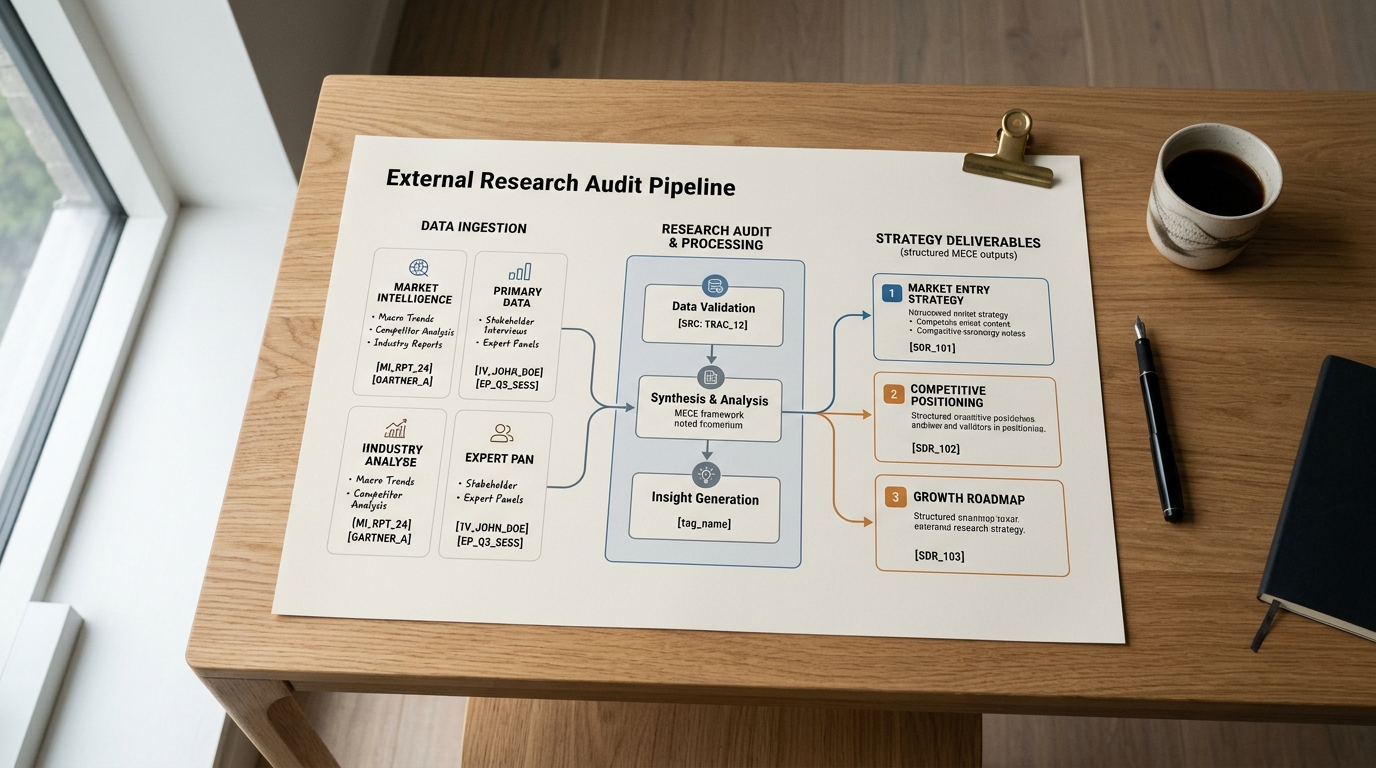
Rigorous market analysis examines market dynamics beyond internal sales pipelines. Corporate strategy teams must synthesize industry reports, regulatory filings, financial disclosures, and primary research to establish objective baselines. Combining top-down market sizing with bottom-up customer validation ensures that market entry or expansion projections reflect true addressable demand.
Ensuring Total Source Traceability and Auditability
In executive decision-making, unverified statistics destroy credibility. Every claim, market estimate, or competitor growth figure embedded in a presentation must be directly traceable to primary evidence. Establishing explicit source traceability and auditability ensures that board members and investment committees can click through to the primary research document, regulatory filing, or financial dataset supporting any strategic assertion.
When strategy deliverables carry transparent source citations, executive leadership can defend strategic choices with confidence during board reviews and stakeholder audits.
Red Flags and Common Failure Modes
Despite the widespread adoption of formal strategic planning, failure rates remain elevated. A McKinsey Quarterly survey of nearly 800 executives found that just 45 percent were satisfied with the strategic-planning process, and only 23 percent said major strategic decisions were made within its confines. Execution suffers as a result: plans that mirror corporate goals on paper often prove ineffective at guiding day-to-day operational trade-offs.
Structural Disconnect Between Strategy and Capital Allocation
The primary failure mode in corporate planning is the premature convergence on financial budgets before strategic options are thoroughly debated. When budgeting leads the process, business units default to defending existing resource allocations. This results in fragmented capital distribution, where strategic priorities receive insufficient funding to achieve critical scale.
Operational Isolation and Front-Line Disconnect
A strategic plan crafted entirely in corporate isolation frequently fails during execution. When front-line operators and business unit leaders are excluded from problem framing, the resulting strategy lacks operational grounding. Without clear decision rights and operational KPIs, middle management treats the strategic plan as a compliance document rather than an operational guide.
| Common Failure Mode | Root Organizational Cause | Observable Red Flag | Remediation Architecture |
|---|---|---|---|
| Strategy-Budget Divorce | Budgeting cycles run parallel to or precede strategic debate | Equal percentage budget cuts across all divisions regardless of strategic priority | Decouple Q2 strategic option selection from Q4 line-item financial budgeting |
| Ungrounded Assumptions | Reliance on unverified internal estimates without primary market data | Financial decks lacking external market citations or competitor verification | Mandate auditability with clickable primary source links for all market claims |
| Front-Line Disconnect | Top-down strategy drafting without operational stakeholder involvement | Vague strategic goals lacking clear milestone owners or execution KPIs | Embed business unit leads in initial MECE problem structuring sessions |
Practical Checklist and Core Implications
To ensure strategic plans withstand board scrutiny and drive operational alignment, strategy leaders must establish rigorous pre-presentation checkpoints. Verifying plan readiness before entering the board room prevents last-minute rework and locks in executive commitment.
Pre-Board Readiness Checklist
Strategy teams should evaluate their strategic deliverables against a standardized readiness framework before presenting to the board or executive committee.
- 1. MECE Problem Framing: Are the overarching strategic goals structured into mutually exclusive, collectively exhaustive sub-issues?
- 2. External Evidence Sourcing: Is every market sizing, growth rate, and competitor claim backed by verifiable primary source data?
- 3. Strategic Option Rigor: Have at least two distinct strategic options been evaluated alongside the recommended pathway?
- 4. Scenario Stress-Testing: Has the plan been tested against adverse macroeconomic and competitive reaction scenarios?
- 5. Clear Resource Allocation: Are capital and headcount allocations explicitly mapped to core strategic initiatives?
- 6. Execution Governance: Are operational decision rights, quarterly milestones, and workstream owners unambiguously assigned?
Core Organizational Implications
Implementing a defensible strategic planning process reshapes organizational behavior. Corporate development teams shift from reactive slide production to proactive strategic steering. By locking in governance cadences and resource commitments early, organizations eliminate ambiguity and enable business units to execute with speed and clarity.
Planning for 2027: timeline October to January
The three phases above describe the full-year cadence. If your 2027 plan starts now, the cycle has to be compressed. The timeline below is a working assumption to adapt to your own budget deadline, not a benchmark. The one rule that must survive compression: strategic option selection comes before budget lock.
| Period | Phase | Deliverable |
|---|---|---|
| October | Phase 1: Ambition and problem framing | Strategic Scoping Brief, problem tree, named decision owners |
| November | Phase 2: Option generation and evaluation | Strategic option scorecards, scenario models, external evidence |
| December | Option selection, then Phase 3: Budget linkage | Selected strategic direction, then capital budget and KPIs |
| January | Sign-off and launch | Board-ready strategic plan, quarterly milestones, decision rights |
If evidence is thin by December, narrow the number of options you commit to and name the open assumptions explicitly. Do not let the budget deadline decide the strategy.
2027 planning checklist
- Is the date of the budget lock known, and is the option decision scheduled before it?
- Are the central strategic challenges structured MECE, with an owner for each?
- Is every market and competitor claim backed by a primary source?
- Have at least two options been compared and stress-tested against adverse scenarios?
- Are capital and headcount tied to the selected initiatives rather than split pro rata?
- Are quarterly milestones and the first review date for 2027 fixed?
How to use this in your next workflow
Integrating a defensible strategic planning process into your next annual planning cycle does not require months of heavy manual administrative work. By combining structured consulting frameworks with advanced AI capabilities, strategy teams can accelerate problem framing, market evidence gathering, and slide creation while maintaining complete source auditability.
An AI-native strategy consulting engine can transform briefs, market research, and internal operational data into board-ready deliverables. Strategy leaders use this kind of tooling to automate MECE problem structuring, evaluate strategic options under detailed scenario analysis, and build audit-proof presentations where every statistic is directly clickable to its underlying source document. By streamlining administrative deck production, strategy teams can reallocate time toward high-value strategic debate and executive alignment.
- Step 1: Ingest Scope and Evidence: Upload internal strategy documents, market research reports, and financial datasets into a secure workspace.
- Step 2: Automate MECE Problem Structuring: Use the AI strategy engine to structure complex strategic challenges into clear, non-overlapping workstreams.
- Step 3: Stress-Test Strategic Options: Conduct scenario analysis and market sizing using fully traceable external and internal data nodes.
- Step 4: Generate Board-Ready Deliverables: Produce executive decks and strategy roadmaps with action titles and verified citations in a single stream.
To streamline your upcoming planning cycle and build strategy roadmaps that survive the room, explore how Decisity elevates your strategy consulting workflow.