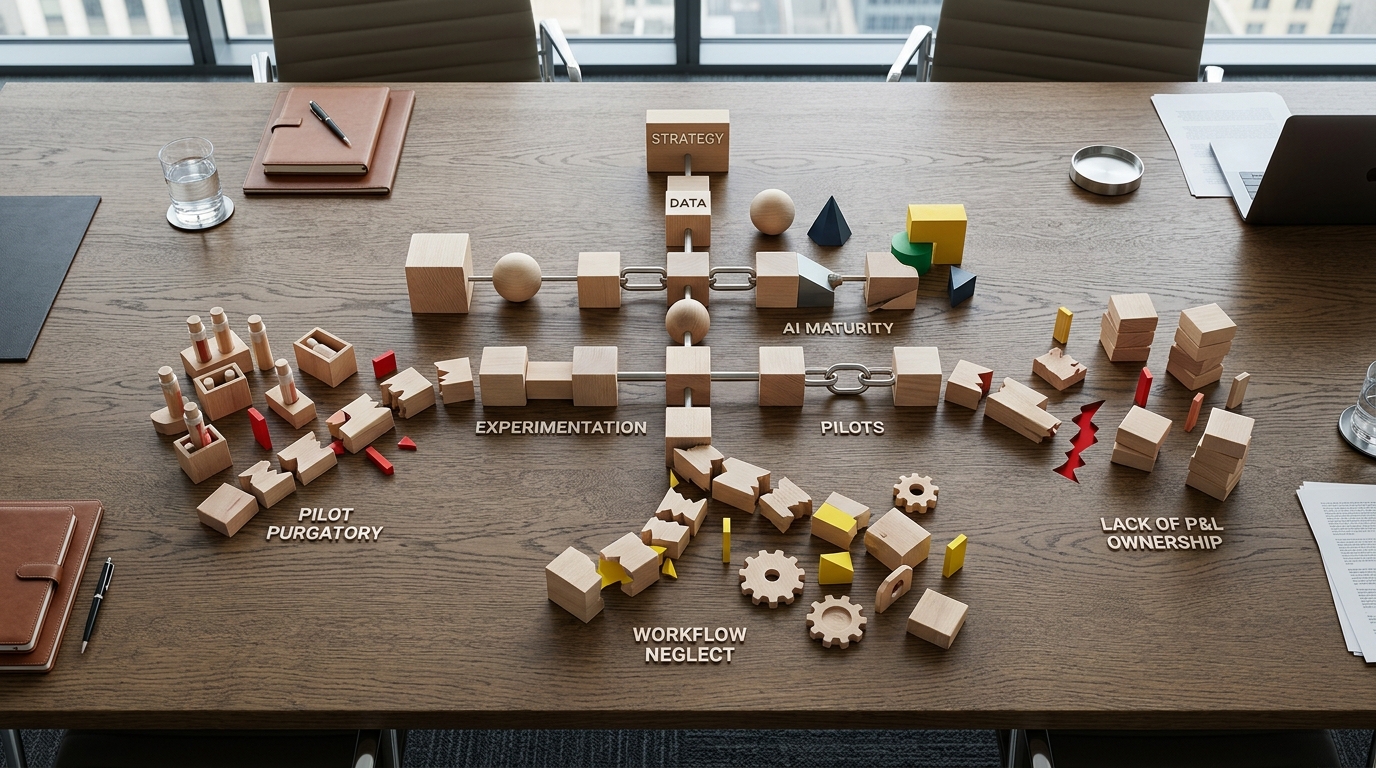
The Strategy-to-Execution Gap and Why Transformations Fail
A business transformation framework provides the operational blueprint required to translate high-level strategic ambition into lasting operational change. While corporate leaders routinely formulate bold strategies, most enterprise transformations stall during implementation because organizations treat systemic operating changes as isolated initiatives. True enterprise transformation requires redesigning the core operating model, establishing explicit capability requirements, assigning single-point accountability, and enforcing objective outcome tracking across every business unit.
Executive teams frequently confuse large-scale strategic transformation with routine project management. Where a standard project delivers a defined output within fixed operational constraints, a genuine transformation fundamentally alters how an organization generates value, makes capital allocation decisions, and serves its end markets.
The strategic cost of failing to bridge this execution gap is immense. Research from Bain & Company, based on a survey of over 400 executives and senior leaders, finds that only 12% of business transformations achieve their original ambition. When strategic intent becomes disconnected from operational reality, organizations experience severe yield loss: strategic value degrades at every hand-off between corporate planning and day-to-day frontline execution.
- Strategic dilution: Executive intent is diluted through middle management layers into generic, low-impact tasks.
- Accountability fragmentation: Initiatives lack single-point executive owners, diffusing responsibility across cross-functional committees.
- Operating model misalignment: New strategic goals are forced into legacy organizational structures and outdated incentive models.
- Activity substitution: Project teams report high milestone completion rates while underlying financial and operational KPIs remain unchanged.
To eliminate yield loss, executive teams must abandon disconnected change efforts and ground their corporate strategy in a cohesive transformation strategy framework that enforces end-to-end architectural rigor.
The Transformation Architecture: A Structured Approach
To close the execution gap, use THE TRANSFORMATION ARCHITECTURE, a structured management methodology that converts boardroom vision into measurable operating outcomes. Rather than launching uncoordinated change workstreams, this framework establishes a disciplined, linear decision logic connecting top-line aspiration to bottom-line results.
The architecture enforces eight sequential stages: strategic ambition -> operating-model change -> capability -> initiative -> owner -> adoption -> KPI -> outcome. Skipping stages in this sequence is the primary cause of organizational friction and squandered capital in enterprise transformations.
- Strategic Ambition: Define the explicit market posture, competitive advantage, and economic targets the business must achieve.
- Operating-Model Change: Determine the structural shifts in organization, processes, technology, and governance needed to support that ambition.
- Capability: Identify the critical organizational muscle, technical assets, and competencies required to compete.
- Initiative: Package capability requirements into tightly scoped, deliverable transformation projects.
- Owner: Assign a single, accountable executive owner empowered with decision rights and direct resource control.
- Adoption: Drive frontline behavioral and process changes necessary for the new capability to take root.
- KPI: Measure leading operational indicators and lagging performance metrics to verify actual adoption.
- Outcome: Realize the targeted financial return, margin expansion, or strategic market advantage.
By adhering to this linear logic, executive leaders prevent the fragmented execution that plagues legacy transformation programs. Every operational initiative maintains a direct, auditable line of sight to a core strategic objective.
Translating Ambition into Operating-Model Implications
A strategic ambition without an operating model transformation remains mere aspiration. When leadership sets a goal, such as entering new digital channels or reducing cost structures, that goal dictates specific changes to how the enterprise operates day-to-day. High-level financial targets must be decomposed into explicit organizational, technological, and process architecture shifts.
Research by McKinsey & Company demonstrates that even top-performing companies achieve only about 70 percent of their strategies' full potential, largely due to shortcomings and misalignments in their operating models. When structural design fails to reflect strategic intent, operational drag rapidly consumes expected returns.
- Technology architecture: Modernizing core platforms, automating critical data pipelines, and dismantling legacy technical debt to support scalable execution.
- Organizational design: Establishing clear spans of control, realigning business units around customer journeys, and decoupling decision authority from bureaucratic hierarchies.
- Core process engineering: Redesigning end-to-end workflows to eliminate friction, reduce cycle times, and embed automated control points.
Holistic operating model design ensures that structural components reinforce one another. If an organization upgrades its technology stack without adjusting its decision rights and operational incentives, productivity gains fail to materialize.
Initiative Prioritization and Clear Ownership
Once required capabilities are defined, management must translate them into concrete, actionable initiatives. However, corporate transformations frequently falter under the weight of initiative overload. When leadership approves dozens of competing programs, organizational attention splinters and mission-critical initiatives lose momentum.
Effective transformation management requires aggressive strategic prioritisation based on net present value, implementation feasibility, and strategic risk. Each prioritized initiative must be assigned to a single, named executive owner rather than a collective committee.
Targeted resource allocation is critical because human capital constraints represent the greatest operational bottleneck. Bain & Company's transformation research indicates that 90% of the value and results of any transformation are created by less than 5% of roles. Overloading key leaders across simultaneous initiatives creates severe burnout and degrades execution velocity.
- Ring-fencing critical talent: Dedicating key talent to high-leverage transformation roles with at least half their time protected for the new role, a practice reported by two-thirds of strong transformers in Bain & Company's research.
- Single-point accountability: Assigning clear decision rights so that initiative leaders have authority over budget, staffing, and operational trade-offs.
- De-prioritization mandates: Formally stopping low-impact legacy projects to free operational capacity for core transformation priorities.
Establishing a robust strategy execution framework ensures that initiative owners maintain full authority over execution paths while remaining accountable for bottom-line delivery.
Driving Adoption Through Change Management
Enterprise transformation fails when leadership treats it solely as a technical or structural exercise. Realizing strategic value requires deep behavioral and cultural adoption across the frontline. Without active adoption, organizations revert to legacy routines as soon as executive attention shifts elsewhere.
Management teams must practice radical transparency regarding the operational realities, capability gaps, and performance expectations of the new model. Vague corporate slogans create cynicism, whereas clear, contrasting definitions of working standards provide operational clarity.
- From consensus-driven delay to single-owner decision velocity.
- From functional silo protection to cross-functional value-stream delivery.
- From milestone-based reporting to verified financial and operational impact.
- From legacy routine preservation to continuous process optimization.
Common failure modes in change adoption include misaligned executive sponsorship, inadequate reskilling programs, and conflicting incentive systems. When performance appraisals reward legacy behaviors, frontline employees inevitably resist new operating processes.
Governance, KPIs, and Tracking Realized Benefits
A transformation requires a governance cadence focused strictly on variance management and benefits realization. Transformation offices often fall into the trap of monitoring project activities rather than operational outcomes. Effective governance tracks whether implemented capabilities generate their intended economic yield.
Executive steering committees must establish clear intervention triggers to identify stalled initiatives early and reallocate capital dynamically.
| Governance Element | Operational Standard | Intervention Trigger |
|---|---|---|
| Leading Indicator Tracking | Monitor weekly user adoption rates and process cycle times | Adoption rate lags the milestone schedule for two consecutive cycles |
| Value Realization Audit | Reconcile initiative P&L impact directly against general ledger accounts | Financial yield falls materially short of the quarterly projection |
| Resource & Capacity Check | Track dedicated full-time equivalent allocation for critical transformation roles | Key talent allocation drops below the agreed protected capacity |
| Decision Bottleneck Review | Measure average turnaround time on cross-functional escalation requests | Escalation resolution exceeds the agreed service window |
During periodic steering committee reviews, executive leaders must maintain rigorous oversight by asking targeted management questions:
- Which specific general ledger line items reflect the financial benefits realized by this initiative to date?
- Where are decision bottlenecks currently slowing operational adoption, and which executive needs to clear them?
- Are our top 5% mission-critical roles fully resourced, or are key operators experiencing initiative overload?
- What leading process metrics indicate that frontline behavior has permanently shifted?
Deploying the Framework in Your Strategy Workflow
Deploying a comprehensive business transformation framework requires embedding structural discipline into your regular strategy cycles. Instead of treating strategy formulation and operational planning as separate annual rituals, executive teams should integrate operating-model design directly into strategic reviews.
- Map strategic ambitions to operational value drivers: Define explicit economic and competitive goals before designing workstreams.
- Conduct an operating model gap assessment: Evaluate current technology, organization, and process capabilities against target ambitions.
- Package capabilities into prioritized initiatives: Apply strict value, feasibility, and risk criteria to prevent portfolio congestion.
- Appoint empowered single-point owners: Assign top-tier talent with dedicated capacity and unambiguous decision rights.
- Establish an outcome-driven governance cadence: Track leading adoption KPIs and financial realization metrics with predefined intervention thresholds.
Decisity supports executive leadership teams through structured strategic analysis, hypothesis-driven problem solving, and operating-model design. By grounding strategic transformation in empirical evidence, value-creation planning, and execution governance, Decisity helps enterprises bridge the strategy-to-execution gap and turn high-level ambition into sustainable operating results.