What is a Strategy Roadmap? Definition & The Core Question
A strategy roadmap is a visual, time-phased governance artifact that defines how an enterprise sequences initiatives, maps causal dependencies, and allocates scarce resources to transition from its current operating state to a target strategic position. Unlike a operational Gantt chart, which tracks tactical task execution and delivery schedules, a strategy roadmap reveals the underlying strategic logic model. It establishes the mandatory sequence of capabilities, market entry gates, and capital investments required to achieve long-term enterprise goals while maintaining strategic coherence.
The core question every strategy roadmap must answer for C-suite leaders and boards is not 'when will work finish?', but 'what prerequisites must be satisfied before downstream strategic initiatives can succeed?'. Research from ClearPoint Strategy demonstrates that only 40% of organizational goals stay on track through implementation. This execution shortfall rarely stems from flawed strategic ambition; rather, it occurs because executive teams treat initiatives as independent workstreams rather than interlinked dependencies.
- Strategic Logic vs. Task Scheduling: Defines causal relationships between capability investments rather than tracking individual activity dates.
- Resource-Constrained Velocity: Paces initiative launches based on real organizational capacity, avoiding simultaneous workstream overload.
- Gate-Based Governance: Establishes clear preconditions and decision rights that must be validated before unlocking downstream capital.
By converting abstract strategic priorities into an auditable sequence, leadership teams gain clarity on the critical path to value creation. Building a rigorous roadmap requires grounding each milestone in verifiable internal data and market context.
Why This Matters: Closing the Strategy Execution Gap
Corporate transformations frequently collapse under the weight of simultaneous execution. When leadership teams approve multiple priority initiatives without establishing a strict chronological sequence, functional teams compete for the same leadership attention, engineering capacity, and balance sheet capital. The same dynamic shows up on the organizational side: silos fragment information about strategic work, departmental goals take precedence over enterprise strategy, and alignment steadily erodes. The result is systemic execution friction, delayed time-to-value, and diluted strategic impact across the portfolio.
Effective roadmapping closes the strategy execution gap by enforcing discipline around initiative ordering. Companies that sequence initiatives explicitly, rather than managing an unstructured portfolio of parallel commitments, give themselves a materially better chance of realizing the value their strategy promises. Sequencing forces executives to make explicit trade-offs early, ensuring that foundational capabilities are operational before dependent market moves are launched.
| Planning Paradigm | Initiative Sequencing | Resource Allocation | Failure Mode |
|---|---|---|---|
| Unstructured Portfolio | Simultaneous parallel launches | Fragmented across all projects | Capacity bottlenecks & high burn rate |
| Sequenced Strategy Roadmap | Causal waves (Capabilities -> Scale -> Optimization) | Focused on active critical path | Disciplined pacing & clear accountability |
Without a sequenced roadmap, corporate strategy remains a collection of isolated targets. Establishing logical progression ensures that early wins generate momentum and self-fund subsequent growth phases.
A Practical Framework for Sequencing Initiatives
Structuring a strategy roadmap requires a mutually exclusive and collectively exhaustive (MECE) framework that categorizes workstreams by strategic horizon and prerequisite dependencies. Rather than arranging projects by departmental preference, strategy teams must group initiatives into distinct execution waves based on structural readiness.
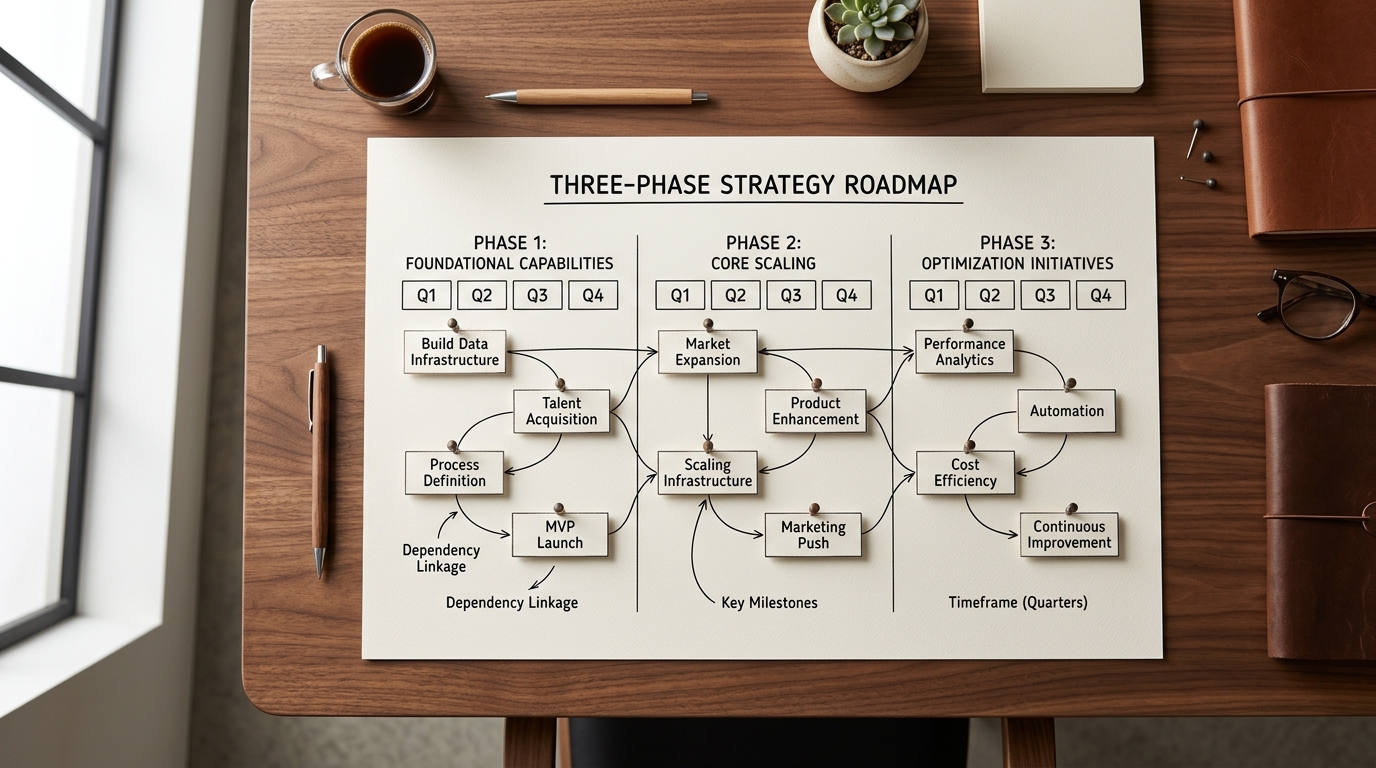
The recommended roadmap framework moves across three chronological phases:
- Phase 1: Foundational Capability Building - Focuses on establishing core infrastructure, operational data structures, compliance architectures, and essential talent needed to support strategic moves.
- Phase 2: Core Scaling & Market Expansion - Deploys established capabilities to capture target market segments, launch core products, and drive primary revenue growth.
- Phase 3: Optimization & Ecosystem Integration - Leverages network effects, automates secondary workflows, and extracts operational efficiencies across the scaled platform.
Explicitly mapping dependencies across these phases prevents costly structural rework. In practice, prioritization is a sequencing exercise: leaders evaluate interdependencies so initiatives run in the optimal order, then adjust the roadmap for constraints on funding, critical skills, technology capacity, and leadership bandwidth. Visualizing dependencies such as vendor delivery timelines or shared platform capacity gives executive sponsors direct insight into which delays will trigger cascading risks across downstream initiatives.
What Strategy Teams and Executives Are Really Testing
When a board or executive committee reviews a strategy roadmap, they are not examining individual project timelines; they are pressure-testing the underlying strategic hypotheses. Strategy leaders must construct the roadmap to withstand intense scrutiny around resource availability, governance capacity, and risk absorption.
Executives evaluate the roadmap against three specific test dimensions:
- Resource Feasibility: Are critical specialized assets and capital available in the quarters where execution workload peaks?
- Causal Validity: Does Initiative B truly depend on Initiative A, or is the timeline artificially stretched by arbitrary calendar quarters?
- Absorptive Capacity: Can frontline operations absorb the magnitude of change required in each phase without disrupting existing cash flows?
Failure to test resource allocation assumptions leads to immediate operational breakdown. Research published by the Project Management Institute, based on a global study of more than 5,800 project professionals and stakeholders, finds that just half of projects meet a modern definition of success, delivering value that exceeds the effort and expense involved as perceived by all key stakeholders. Ensuring that capacity constraints are explicitly modeled transforms the roadmap from an optimistic wish list into an executive-grade operating plan.
The Evidence and Analysis Required for Dependency Mapping
Accurate dependency mapping requires rigorous empirical analysis rather than executive intuition. Strategy teams must gather hard evidence across technical, financial, and operational vectors to classify dependencies into two distinct categories: mandatory logical dependencies and discretionary resource-based dependencies.
Mandatory logical dependencies represent immutable physical or technical constraints (for example, a proprietary algorithm cannot analyze customer telemetry until data ingestion pipelines are built). Discretionary dependencies reflect strategic choices regarding capital sequencing or risk management. Distinguishing between these categories allows strategy leads to preserve flexibility when executive priorities shift.
| Dependency Type | Definition | Evidence Required | Roadmapping Impact |
|---|---|---|---|
| Mandatory Logical | Technical or operational prerequisites that cannot be bypassed | Architecture audits, technical debt assessments, regulatory requirements | Non-negotiable sequence gate |
| Discretionary Resource | Scheduling constraints driven by shared human capital or budget limits | Capacity utilization models, cash flow forecasts, talent allocation maps | Flexible sequence based on executive choice |
To establish an audit-ready dependency map, strategy teams must synthesize market readiness data, balance sheet liquidity schedules, and internal operational audits into a single analytical foundation.
Red Flags and Common Failure Modes in Roadmapping
Even well-intentioned roadmapping efforts frequently fall into structural traps that undermine execution. Identifying these failure modes during drafting enables strategy teams to correct fatal assumptions before presenting to the board.
The most widespread roadmapping traps include:
- The Everything-Is-Priority-One Trap: Approving a long list of parallel workstreams in Quarter 1 due to political pressure, resulting in resource starvation across all projects.
- Ignoring Sequential Prerequisites: Scheduling market expansion or commercialization phases before underlying technical platforms or regulatory clearances are finalized.
- The Shared Resource Illusion: Assigning the same key personnel to several simultaneous initiatives at near-full capacity, creating severe operational friction and burnout.
Assigning key subject matter experts to multiple critical path initiatives simultaneously creates invisible bottlenecks that delay entire portfolios, because the constraint sits with scarce talent rather than with the calendar. Recognizing these red flags early ensures the roadmap remains grounded in operational reality.
A Practical Checklist for Building the Roadmap
Use the following checklist to construct an executive-ready strategy roadmap during your next planning cycle:
- Define the Strategic Destination: Quantify the end-state financial and operational outcomes required over a 2 to 3 year horizon.
- Audit Capability Baselines: Conduct an inventory of existing assets, technical infrastructure, and operational gaps.
- Draft Initiative Statements: Express each initiative as a distinct, measurable value creation project with clear ownership.
- Identify Mandatory Prerequisites: Map technical and logical dependencies using empirical data and expert reviews.
- Conduct Capacity Stress-Testing: Verify that shared human and financial resources are not over-allocated during peak quarters.
- Establish Decision Gates: Set explicit governance thresholds required to release capital for downstream phases.
Practical Implications for Strategy Leaders
Sequencing discipline changes what leadership teams actually decide. For heads of strategy, it means the annual plan is approved as a set of gated waves rather than a portfolio of parallel commitments, so capital release is tied to evidence that prerequisites are in place. For corporate development, it means acquisition and partnership timing is set by capability readiness rather than deal availability, since integration capacity is usually the binding constraint. For CEOs and boards, it shifts the governance conversation from status reporting to constraint management: which shared resource is the current bottleneck, which dependency is slipping, and which downstream initiative must therefore move. Practically, that requires naming a single owner per initiative, publishing the dependency map alongside the timeline, and re-baselining the roadmap each quarter rather than defending the original dates.
How to use this in your next workflow
In your next planning cycle, run the roadmap as a short working sequence rather than a document review. The checklist above defines what the artifact must contain; the steps below define how to produce and defend it in the room.
- Run a two-hour dependency workshop with functional leads before any dates are drawn, and capture every prerequisite as a named deliverable with an owner.
- Load the resulting initiatives into a single capacity view by quarter, then move start dates until no critical individual or budget line is over-committed.
- Classify each remaining link as mandatory or discretionary, and mark the discretionary ones as the levers you will pull if conditions change.
- Write the decision gate for each phase as a testable condition, so the board approves a rule rather than a date.
- Bring one page to the executive review: the sequence, the binding constraints, and the two dependencies most likely to slip.
- Re-baseline quarterly, recording which assumption broke so the next roadmap is calibrated on evidence rather than optimism.
For corporate development teams, heads of strategy, and private equity leaders, transforming strategic analysis into board-ready deliverables requires absolute rigor. Leveraging modern platforms like an AI-native strategy consulting solution allows strategy teams to streamline problem framing, structure complex initiatives MECE, and produce auditable roadmaps backed by traceable sources. Using an AI-native platform enables strategy leaders to rapidly test scenarios, generate board-ready strategy decks, and communicate strategic intent with clarity.
Frequently Asked Questions
What is the difference between a strategy roadmap and a project plan?
A strategy roadmap focuses on strategic direction, sequencing initiatives, mapping causal dependencies, and gating resource allocation over a multi-year horizon. A project plan focuses on operational task schedules, daily work assignments, individual deliverables, and tactical timelines within a single initiative.
How far into the future should a strategy roadmap project?
Most enterprise strategy roadmaps span a horizon of 2 to 3 years. Near-term phases (quarters 1 to 2) feature high detail and firm commitments, while medium-to-long-term phases (year 2 and beyond) represent strategic intent that adapts as market conditions evolve.
How do you handle changing market conditions on a strategy roadmap?
Roadmaps should be living governance frameworks reviewed quarterly. When market conditions shift, executives re-evaluate discretionary dependencies and scenario models without abandoning the foundational logic model or mandatory technical prerequisites.
Why do roadmaps fail during execution?
Roadmaps primarily fail when organizations attempt too many initiatives simultaneously, ignore mandatory sequential prerequisites, over-allocate key personnel across parallel projects, or lack clear objective ownership.
How do you map dependencies between cross-functional teams?
Dependency mapping requires conducting structured workstream audits to identify shared systems, required technical deliverables, and critical path talent, then establishing explicit sequence gates between phases.
Meta Title: Strategy Roadmap Guide: Sequencing Initiatives & Dependencies
Meta Description: Learn how to build an executive-grade strategy roadmap by sequencing initiatives, mapping causal dependencies, and aligning scarce resources to close the strategy execution gap.