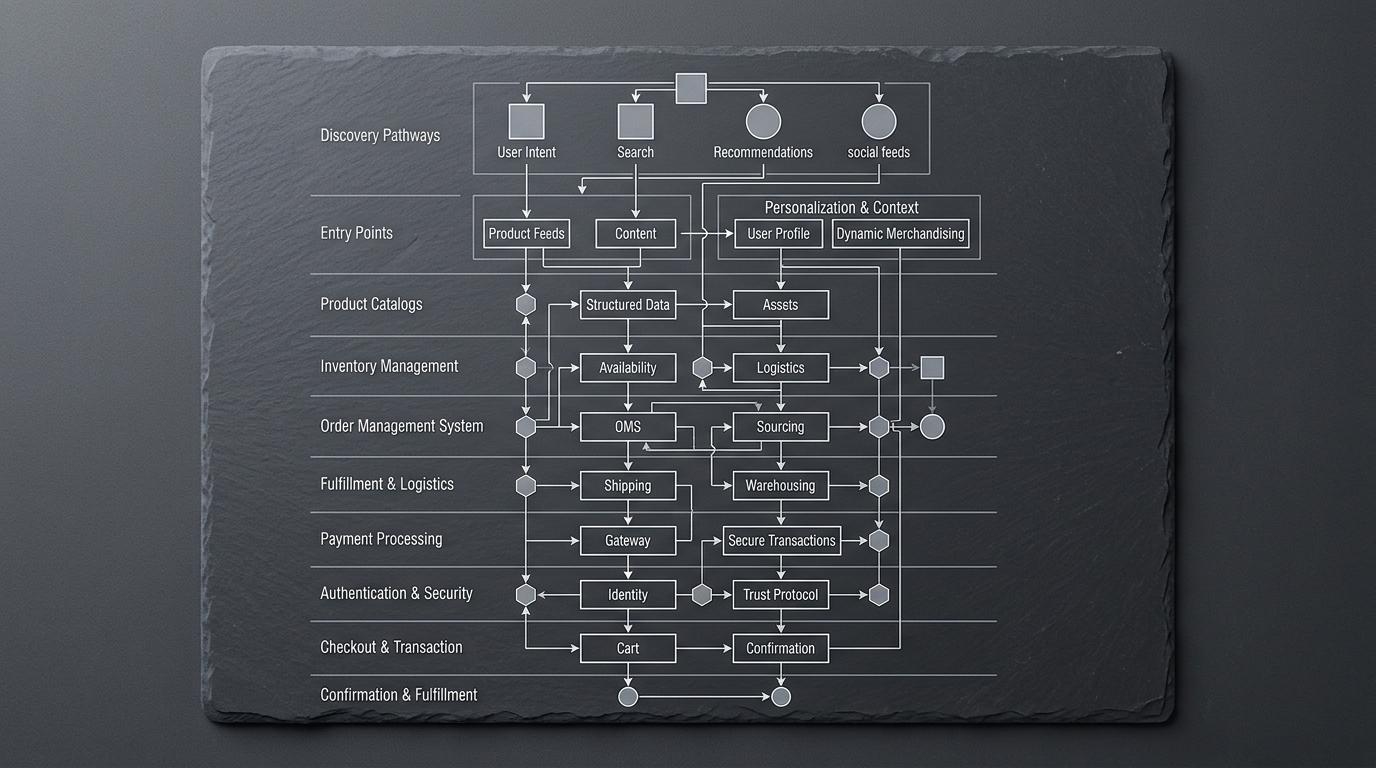
What is agentic commerce? From feature to infrastructure
Agentic commerce represents the structural shift from visual, human-driven web browsing to autonomous machine-to-machine transactions. In traditional digital retail, buyers manually navigate catalogs, compare specifications, evaluate alternatives, and execute linear checkouts across browser tabs. In an agentic commerce model, autonomous AI shopping agents act as delegated representatives. These agents continuously parse product metadata, query inventory levels, evaluate dynamic pricing, and complete multi-step transactions on behalf of individual shoppers or enterprise procurement teams without requiring manual human clicks at every step.
This transition fundamentally alters how commercial transactions occur. Adyen's industry analysis of agentic commerce notes that agents query systems continuously for pricing, availability, shipping options and product details throughout a session, and in more advanced cases maintain context across interactions and complete transactions autonomously, while most commerce infrastructure was never designed for that pattern. When purchasing decisions shift from human emotional impulse to programmatic agent evaluation, commerce platforms cease to be visual storefronts. Instead, they operate as back-end programmatic infrastructure that requires rigorous agentic AI governance, machine identity verification, and real-time data synchronization.
| Traditional ecommerce | Agentic commerce | Strategic implication |
|---|---|---|
| Visual storefronts optimized for human browsing and graphic merchandising | Machine-readable API endpoints queried continuously by autonomous software agents | Distribution priority shifts from page layout design to structured data schema depth |
| Linear session checkouts requiring manual payment input and two-factor user prompts | Programmatic execution via cryptographic machine identity and tokenized agent credentials | Checkout conversion depends entirely on API uptime, latency, and machine authorization protocols |
| Discovery driven by consumer keyword search, sponsored rankings, and paid ads | Deterministic attribute matching based on verifiable specifications and real-time inventory | Competitive moat transitions from ad spend and SEO copy to verified product accuracy |
For enterprise leaders, treating agentic commerce as a peripheral chatbot or front-end widget is a fatal framing error. Winning machine-mediated demand requires re-architecting foundational enterprise systems: transforming product catalogs into machine-readable knowledge graphs, exposing reliable availability APIs, and establishing verifiable transaction protocols that autonomous agents can trust.
Why this infrastructure shift matters right now
Treating agentic commerce as an experimental marketing channel misjudges where digital distribution is heading. Commercial discovery is already consolidating inside conversational interfaces. Research by OpenAI's Economic Research team and Harvard economist David Deming found that around 2% of all ChatGPT queries involve shopping, about 50 million queries per day. AI platforms are actively filtering options, comparing merchant offers, and shaping purchasing intent long before a user visits an e-commerce website.
Distinguishing infrastructure readiness from mass consumer adoption
Executive teams must make a clear distinction between current technical readiness and widespread consumer delegation. Fully autonomous shopping agents that execute purchases end-to-end without human intervention are not yet ubiquitous. However, waiting for consumer adoption to peak before building backend capability guarantees disintermediation. When agents perform high-frequency product evaluation, systems lacking structured feeds, real-time inventory endpoints, and rigorous agentic AI governance protocols will simply be bypassed.
- Query volume precedes autonomous execution: Millions of shoppers already rely on AI agents for product research, specification matching, and price comparisons, even when human hands click the final checkout button.
- Infrastructure lead times require immediate investment: Architecting machine-readable catalog structures, dynamic pricing APIs, and tokenized payment authorizations requires substantial development cycles before agent traffic surges.
- Discovery advantage compounds early: AI recommendation engines favor reliable, low-latency, and verifiable data sources, creating structural search advantages for early infrastructure adopters.
Organizations that view agentic commerce solely as a frontend feature will fall behind. Establishing the backend infrastructure today ensures your enterprise remains discoverable, trustworthy, and fully transactable as autonomous shopping agents become the primary gatekeepers of commerce.
The Agent-Ready Commerce Stack: Discovery to Identity
Autonomous agents do not browse visual web storefronts; they query structured data endpoints. Capturing demand in an AI-mediated market requires building backend infrastructure that machines can crawl, verify, and execute deterministically. Morgan Stanley Research estimates that agentic shoppers could reach $190 billion to $385 billion in U.S. e-commerce spending by 2030, capturing 10% to 20% of online retail, making operational readiness across core technical layers essential for market presence.
Layers 1 to 5: Establishing Machine Readability and Trust
- Discovery: Exposing semantic endpoints, agent-readable manifest files, and structured metadata. Unstructured HTML and fragmented web pages obscure product catalogs, leaving offerings invisible to autonomous search agents.
- Structured Product Information: Providing granular, standardized attributes, verified specifications, and strict taxonomy models rather than ambiguous marketing copy.
- Availability: Publishing real-time, low-latency inventory feeds across regional fulfillment nodes to prevent checkout failures and inaccurate agent commitments.
- Pricing: Exposing deterministic pricing structures, automated tiering, localized taxes, and dynamic discounting rules that computational agents can calculate instantaneously.
- Identity: Authenticating the shopping agent, the operating platform, and the human principal through cryptographic verifiable credentials, aligning transactional delegation with established agentic AI governance frameworks.
Without these foundational layers, unstructured catalog data introduces latency, parsing errors, and hallucination risks that cause AI evaluators to bypass unready merchants entirely. Structuring data from discovery to identity ensures an enterprise remains fully legible to autonomous software.
The Agent-Ready Commerce Stack: Authorization to Governance
The execution half of the 10-layer Agent-Ready Commerce Stack bridges strategic intent and automated settlement. Once an autonomous agent discovers inventory and evaluates real-time pricing, the architecture shifts to strict cryptographic trust. Layers 6 through 10 govern how transactions execute securely in an automated environment:
- 6. Authorization: Scoped cryptographic tokens that bound an AI agent to predefined spend limits, merchant categories, and expiry windows.
- 7. Payments: Machine-native settlement protocols capable of programmatic authentication without human biometric prompts.
- 8. Fulfilment: Automated dispatch routing, dynamic delivery slot booking, and programmatic inventory allocation.
- 9. Post-Purchase: Machine-readable tracking APIs, automated dispute routing, and programmable returns handling.
- 10. Auditability and Governance: Complete immutable transaction logs, intent verification records, and compliance oversight for autonomous actions.
Global payment networks are actively re-architecting infrastructure to support autonomous buying at scale. Visa states that there are 4.8 billion Visa credentials in circulation today, and that it intends to extend that network to AI agents transacting at accepting merchant locations through tokenized, AI-ready credentials. Alongside that, Visa's Trusted Agent Protocol, developed in collaboration with Cloudflare, establishes a framework that enables secure communication between AI agents and merchants during every step of a transaction, so merchants can recognise trusted agents with commerce intent instead of blocking them as malicious bots. This transition ensures that autonomous agents do not trigger legacy fraud heuristics while preserving end-to-end consumer identity.
For enterprise strategy leaders, operationalizing these final layers requires treating machine governance as a foundational business capability rather than a technical afterthought agentic AI governance. Ensuring that every programmatic transaction leaves a traceable audit trail protects merchant margins and maintains enterprise compliance.
Executive implications: Red flags and decision questions
Transitioning to agentic commerce requires executives to evaluate legacy enterprise architectures against machine-mediated purchasing. Monolithic commerce suites that bury catalogues behind client-side JavaScript or blunt bot-blocking firewalls risk immediate invisibility to AI shoppers. Leaders must establish clear programmatic interfaces while implementing protocol-level merchant opt-in to preserve pricing control, margin integrity, and brand safety.
Structural red flags in enterprise commerce
- Monolithic frontend lock-in: Product data, stock levels, and checkout flows are coupled to graphical user interfaces rather than exposed via decoupled headless APIs.
- Indiscriminate traffic mitigation: Security perimeters block all automated agents at the network edge instead of differentiating malicious scrapers from legitimate consumer-owned buying agents.
- Absence of protocol registration: The organisation lacks registered merchant credentials across emerging agent payment standards. Under Visa's Trusted Agent Protocol, for example, merchants (or their site protection providers) verify signed credentials that identify an approved agent acting on a consumer's behalf with commerce intent, and can request additional consumer information during checkout.
Executive readiness assessment
| Architectural Dimension | Strategic Decision Question | Verifiable Evidence Required |
|---|---|---|
| Catalogue & Availability | Can autonomous shopping agents query live stock and SKU attributes programmatically? | Structured schema.org markup and sub-second API endpoint availability. |
| Protocol & Trust Opt-in | Has the enterprise enabled cryptographic validation for agentic checkouts? | Active integration with network tokenization and agent signature standards; the agent recognition signature in Visa's Trusted Agent Protocol is based on HTTP Message Signatures (RFC 9421). |
| Governance & Dispute Control | Are transaction audit logs structured to trace automated purchase commitments? | Machine-readable logs embedded in the executive decision-making framework. |
Navigating these architectural shifts requires cross-functional alignment across IT, commercial strategy, and risk operations. Leaders who audit their infrastructure today will ensure their digital storefront remains discoverable, transactable, and trusted as autonomous purchasing scales.
How to use this protocol in your next workflow
Transitioning from theoretical readiness to operational deployment requires technical and commercial leaders to embed agentic commerce protocols directly into existing product roadmaps. Rather than rebuilding backend commerce architectures from scratch or locking systems into closed vendor ecosystems, engineering teams should execute a phased implementation that isolates agent interactions behind modular, interoperable API gateways.
A three-step roadmap for engineering and product teams
- Map and expose machine-readable offer feeds: Convert existing product catalogs into structured schema and real-time metadata endpoints. Published product-feed guidance for agentic checkout requires exactly this, a structured catalog feed carrying up-to-date product data so AI shopping surfaces can index your products and present accurate product information.
- Pilot delegated authorization and tokenized checkout: Integrate merchant-owned network tokens and programmatic authorization boundaries to handle agent-initiated transactions. Establishing explicit mandate limits for spending caps, purchasing frequency, and contextual approvals ensures buyers retain control while minimizing operational fraud risk.
- Validate interoperability against open protocol standards: Test transactional endpoints across open specifications, including the Agentic Commerce Protocol, an open standard for programmatic commerce flows between buyers, agents and businesses. Benchmarking system behavior against open standards prevents vendor lock-in and confirms that authentication handshakes remain portable.
Embedding these technical milestones into broader agentic AI governance frameworks ensures that checkout automation remains auditable from day one. Establishing clear logging across machine-speed transactions protects enterprise liability while preserving direct brand-to-consumer relationship continuity as agent ecosystems scale.
How Decisity supports the workflow
Operating within the agentic commerce stack requires moving beyond static web pages to programmatic, verified execution. In the post-purchase and auditability layers, enterprise infrastructure must guarantee that autonomous shopping agents receive precise, verifiable data regarding order status, fulfillment tracking, and dispute management. That calls for a strategic and operational architecture that structures enterprise knowledge, enforces data boundaries, and makes automated interactions auditable.
Structured Knowledge Sync and Human-in-the-Loop Fallbacks
When autonomous systems query backend systems for policy details, returns, or technical specifications, responses cannot rely on probabilistic guesswork. Decisity enables organizations to maintain an EU-hosted, structured knowledge layer that synchronizes directly with AI agents. By anchoring every transaction and customer service inquiry to verified enterprise documentation, the platform ensures that machine-to-machine interactions never hallucinate terms or misrepresent inventory policies.
- Source-grounded response verification: Every automated claim or transaction response links directly to verified internal documentation, preventing ungrounded commitments.
- Deterministic exception routing: Queries exceeding agent confidence thresholds or policy parameters automatically escalate to human supervisors in a unified queue.
- Audit-ready operational records: Complete interaction histories and data provenance remain fully traceable for governance and compliance reviews.
MIT Sloan professor Kate Kellogg puts it directly: "As you move agency from humans to machines, there's a real increase in the importance of governance and infrastructure to control and support agentic systems." By establishing robust agentic AI governance, business leaders protect brand equity and customer trust while positioning their commerce infrastructure to capture growing agent-mediated volume.
Teams can pressure-test agent-readiness alongside their broader digital and AI strategy using the AI strategy engine.