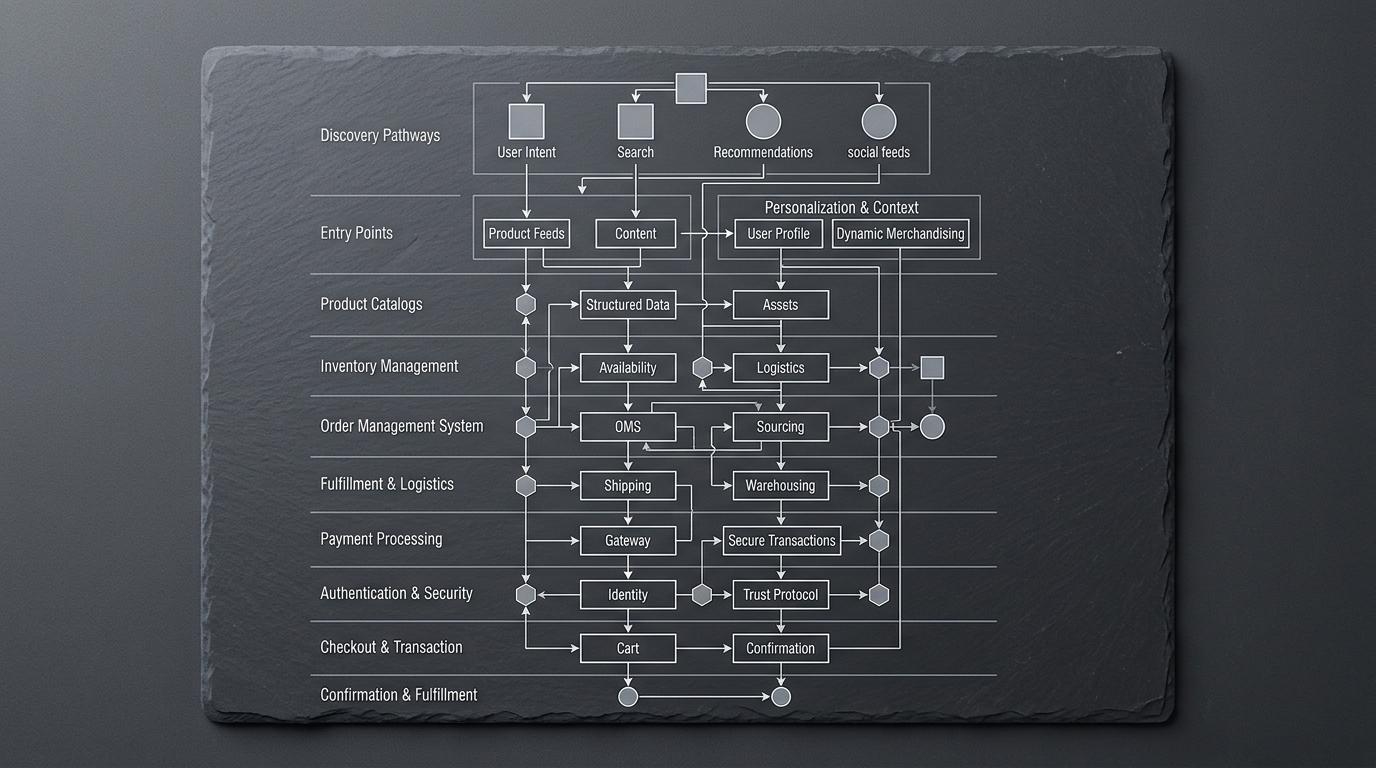
The Agentic Commerce Shift: Why Capability Sourcing Matters Now
An executive agentic commerce strategy determines whether an enterprise captures autonomous revenue or cedes transaction discovery to third-party algorithms. Sourcing agentic capability is not a uniform software upgrade; it requires a structured choice between buying proprietary targets, building in-house engines, partnering with ecosystem providers, or experimenting while standards stabilize. Leaders must balance immediate time-to-market against the fatal risk of acquiring commoditized infrastructure. By structuring capital allocation around clear data maturity and verifiable unit economics, leadership teams can secure defensible competitive moats without locking the organization into rigid, brittle architectures.
Digital commerce is undergoing a structural transition from human-driven browsing to machine-mediated procurement. Research from McKinsey projects that agentic commerce could orchestrate as much as $3 trillion to $5 trillion in global retail revenue by 2030, and up to $1 trillion in the United States alone. This commercial migration is accelerating across both business-to-consumer and business-to-business environments. The Braze Retail Customer Engagement Review reveals that consumer adoption of agentic shopping is expected to surge from 19% to 46% by late 2026. Concurrently, automated and agent-driven web traffic is expanding rapidly, underscoring why leaders should prepare commerce infrastructure for machine-mediated demand.
The Strategic Dilemma: Speed Versus Architectural Lock-In
For chief executive officers, chief strategy officers, and chief digital officers, the central operational tension lies in closing capability gaps rapidly without taking on unhedged technical debt. Rushing into proprietary vendor agreements creates vendor lock-in around rapidly shifting machine-learning models. Conversely, delayed action risks total disintermediation as autonomous agents route purchasing decisions away from legacy digital storefronts. Executive teams must evaluate capability sourcing through a rigorous governance lens rather than treating it as an ad hoc technology procurement.
- Shift from manual storefront optimization to autonomous machine discovery and real-time algorithmic negotiation.
- Growing exposure to third-party interface disintermediation as software agents bypass traditional search and display channels.
- Accelerating commercial stakes requiring disciplined capital deployment across build, buy, and partner pathways.
THE BUY-BUILD-PARTNER DECISION: A Strategic Framework
Navigating the shift toward autonomous digital channels requires an updated ecommerce AI strategy. Traditional technology selection frameworks assume static application programming interfaces and predictable multi-year lifecycles. In contrast, agentic systems operate through dynamic reasoning, continuous policy adaptation, and emergent multi-agent ecosystems. Executive teams need a modernized strategic decision-making framework tailored to these autonomous operating realities.
The Buy-Build-Partner Decision evaluates capability sourcing across four distinct strategic postures: Buy, Build, Partner, and Wait or Experiment. Each posture addresses specific corporate conditions, data assets, and execution risks. Deciding between buy vs build AI requires assessing whether the capability delivers differentiated customer value or merely fulfills baseline infrastructural requirements.
The Four Capability Sourcing Postures
- BUY: Appropriate when the capability creates lasting strategic differentiation, time-to-market is compressed, proven back-end integration exists, and proprietary intellectual property or scarce talent cannot be replicated internally within eighteen months.
- BUILD: Recommended when the capability touches core competitive advantages, proprietary enterprise workflows, unique customer data graphs, or internal system integration yields a defensible margin moat.
- PARTNER: Optimal when industry interface standards are evolving rapidly, the capability represents non-differentiating transactional infrastructure, and operational flexibility outweighs absolute software ownership.
- WAIT / EXPERIMENT: Necessary when end-user adoption patterns remain volatile, unit economics are unproven, or underlying technical protocols have not yet reached enterprise consensus.
| Decision | Best when | Evidence needed | Main risk |
|---|---|---|---|
| BUY | Strategic differentiation is high, time-to-market is critical, and talent or proprietary models cannot be built in-house. | Validated target gross margins, proven API integrations, and audited data compliance records. | Overpaying for ephemeral capabilities or suffering post-merger integration friction. |
| BUILD | Capabilities touch proprietary customer data, unique supply-chain logic, or core operational workflows. | Internal engineering capacity, clean data architecture, and clear multi-year cost advantages. | Budget overruns, extended delivery delays, and internal talent attrition. |
| PARTNER | Transactional infrastructure is standardizing rapidly and flexibility across multiple platforms is vital. | SLA performance benchmarks, SOC-2 compliance, and transparent multi-agent API connectivity. | Ecosystem dependency, sudden vendor margin extraction, and platform interface changes. |
| WAIT / EXPERIMENT | Market demand is speculative, unit economics are negative, or protocols remain in active flux. | Low-cost sandbox metrics, user cohort feedback, and verifiable conversion baselines. | Losing first-mover data collection loops and falling behind agile competitors. |
Modern corporate leaders must treat this decision matrix as a dynamic portfolio rather than a one-time transaction. A company might build its internal knowledge retrieval layer while partnering for payment settlement protocols and executing targeted acquisitions for vertical-specific domain models.
The Protocol Principle: Do Not Acquire What Will Become Standard
A fundamental rule of modern AI platform strategy and AI M&A strategy is the Protocol Principle: do not acquire what is about to become an open protocol. In digital commerce history, proprietary networking stacks, content syndication formats, and messaging layers commanded temporary valuations before open standards commoditized them. The same structural dynamic is unfolding across autonomous commerce ecosystems.
Open interoperability frameworks are standardizing the mechanics of agent discovery, context retrieval, and transaction settlement. Anthropic's Model Context Protocol (MCP) establishes standardized connections between autonomous agents and the systems where enterprise data lives, including content repositories and business tools. Concurrently, Stripe and OpenAI co-developed the Agentic Commerce Protocol (ACP) as an open standard for agent-led checkout, while the Agent2Agent (A2A) protocol, launched by Google with support from more than 50 technology partners, is an open protocol that lets agents communicate, exchange information securely, and coordinate actions across vendors and frameworks. When foundational interaction standards are codified into open protocols, paying an acquisition premium for basic connective plumbing represents misallocated capital.
Applying the Guideline in Enterprise Architecture
The Protocol Principle should serve as an analytical guideline rather than an inflexible mandate. Acquiring proprietary integration tooling can be justified if it captures a substantial market window or secures scarce talent ahead of a strategic roll-out. However, leadership must confirm that the target's value proposition resides in its data assets, domain-specific logic, or workflow orchestration, rather than in generic protocol bridges. Aligning capability sourcing with rigorous agentic AI governance ensures that the enterprise maintains architectural sovereignty as industry protocols mature.
- Differentiate between proprietary algorithmic defensibility and temporary interface wrappers.
- Evaluate open-source protocol roadmaps before committing corporate development capital to integration targets.
- Structure enterprise software layers to decouple proprietary business logic from commoditized protocol adapters.
Evaluating the Options: Decision Questions and Evidence Checklist
Before selecting a build vs buy AI path, executive committees must conduct disciplined commercial due diligence across internal capabilities and external market offerings. Evaluating agentic readiness requires measuring operational resilience alongside algorithmic accuracy. Commerce platform vendor commercetools frames this as a question of foundational readiness: agents rely on real-time responses to check prices, validate inventory, create carts, apply promotions and place orders, so modular APIs give agents the resilience they need while monolithic systems add latency and failure risk. The same real-time primitives appear in the open agentic checkout specifications now published for merchant integrations.
Enterprise readiness rests on three foundational pillars: catalog data maturity, transactional API throughput, and policy guardrails. If a company's product specifications, inventory states, and contractual terms are inconsistent across legacy silos, external AI agents cannot parse or execute orders reliably. The evaluation checklist below structures the inquiry across both B2B procurement and B2C retail contexts.
Executive Decision Questions
- Data Sovereignty: Does this capability rely on proprietary operational data that cannot leave our enterprise security perimeter?
- Protocol Exposure: Is this software solving a fundamental reasoning problem or merely bridging an interface that open protocols will resolve within twelve months?
- Operational Resilience: Can our existing transaction architecture handle multi-agent queries, automated micro-negotiations, and high-frequency inventory checks without downtime?
- Unit Economic Defensibility: Does the build or partner cost scale predictably with transaction volume, or does API token consumption erode operating margins?
The Capability Sourcing Evidence Checklist
- Structured Data Feeds: Real-time, machine-readable product specifications, dynamic pricing tables, and SLA parameters verified via automated test suites.
- API Reliability and Latency: Sub-second response times for programmatic catalog lookups, cart building, and delegated checkout authorizations.
- Auditability and Traceability: Complete immutable logging for every autonomous agent interaction, pricing negotiation, and order settlement.
- Human Fallback Architecture: Deterministic escalation triggers that route ambiguous queries or boundary exceptions to human operators before commitments are finalized.
Navigating the Risks: Strategic Red Flags in AI Deals
When executing an AI partnership strategy or M&A transaction execution, deal teams frequently encounter fatal execution traps. The most common point of failure is prioritizing algorithmic novelty over back-end data architecture. An AI engine without a unified, clean data foundation will produce hallucinations, inaccurate pricing commitments, and compliance breaches.
A research study by Accenture covering 650 senior dealmakers found that organizations expect agentic AI maturity in post-deal integration and value capture to grow by 72%. Despite this expectation, many acquirers treat data infrastructure and algorithmic readiness as post-close operational afterthoughts. Neglecting core architectural compatibility during diligence directly erodes the investment thesis.
Critical Warning Signs in AI Capability Sourcing
- Fragmented Data Silos: Targets or internal systems requiring extensive manual data normalization before agents can access inventory or customer context.
- Absence of Policy Bounds: Solutions that lack strict, programmatic constraints on automated discounts, contractual commitments, and order rerouting.
- Lack of Explicit Source Verification: Platforms that cannot point to an audited knowledge record or internal database entry for every output generated.
- Integration Fragility: Solutions dependent on undocumented scraper interfaces or brittle browser-automation routines rather than resilient API standards.
Executive teams must establish clear termination criteria during deal structuring. If an external acquisition target cannot demonstrate verifiable compliance logging or if an internal build project consistently misses latency milestones, capital should be redirected to standardized partnership models.
Implementation: How to Use This in Your Next Workflow
Translating an agentic commerce strategy into corporate execution requires disciplined phasing. Leadership teams should avoid multi-year monolithic rollouts in favor of staged, value-accretive implementation cycles. By combining hybrid technology architectures with continuous organizational upskilling, enterprises can capture early commercial advantages while preserving capital flexibility.
Phased Implementation Roadmap
- Establish Strategic Framing: Convene CDO, CSO, and CFO leadership to classify commercial capabilities into core proprietary workflows versus commoditized infrastructure.
- Deploy Build-to-Learn Prototypes: Fund time-boxed, low-risk pilot environments targeting specific operational bottlenecks such as automated catalog enrichment or B2B reordering.
- Vet Hybrid Architecture Integrations: Combine internal proprietary knowledge layers with external protocol-compliant partner APIs for transaction processing.
- Operationalize Workforce Upskilling: Reconfigure operational roles from manual transaction processing to policy design, boundary auditing, and exception management.
- Scale Governed Production: Transition validated prototypes to live customer channels with continuous telemetry on conversion efficiency, token economics, and error rates.
By institutionalizing small, measurable milestones, executive teams validate unit economics before committing major balance-sheet capital. This iterative discipline prevents costly integration failures while ensuring that digital commerce operations evolve in step with market adoption.
Securing the Architecture: How Decisity Supports the Workflow
Regardless of whether an organization chooses to buy, build, or partner, every agentic commerce architecture requires a foundational knowledge and governance layer. Autonomous systems cannot transact reliably if their underlying reasoning is detached from verified enterprise truth. Decisity provides an orchestrated strategy platform that unifies corporate knowledge assets into traceable, auditable inputs for strategic decision-making and operational execution.
By indexing structured documentation, business policies, and commercial terms, the platform feeds enterprise agents with verifiable data grounded directly in verified source material. When autonomous agents encounter ambiguous queries or edge cases outside authorized parameters, the system triggers deterministic human fallback workflows to protect brand equity and customer trust. This combination of source traceability and risk mitigation empowers executive leadership to deploy agentic capabilities with complete operational confidence.