Why AI Search Ecommerce Matters Now
AI search ecommerce represents a structural pivot in how consumers discover, evaluate, and purchase products online. Rather than parsing paginated search results, shoppers increasingly rely on conversational answer engines like ChatGPT, Google AI Overviews, Perplexity, and Gemini to synthesize complex requirements into specific product recommendations. Traditional search traffic is not vanishing overnight, but discovery is shifting into a hybrid environment where organic search engines and generative models operate side by side. Brands that fail to structure their data for generative engine optimization ecommerce risk becoming invisible to conversational discovery.
The commercial stakes behind this migration are accelerating rapidly. Machine-driven commerce is already scaling: Adobe Analytics found that traffic to US retail sites from generative AI tools rose 693% year over year during the 2025 holiday season (November to December). Generative interfaces do not merely route traffic; they compress the consideration phase by synthesizing reviews, specifications, and retailer reliability before the customer ever clicks an outbound link. When an AI shopping assistant evaluates candidate products, it filters out unverified claims and unstructured pages, prioritizing merchants whose offerings can be reliably parsed and verified.
Establishing visibility in this new landscape requires growth leaders to conduct rigorous market competitive analysis across conversational engines as well as traditional search result pages. The commercial challenge is no longer just ranking on page one of Google; it is qualifying for real-time synthesis across generative recommendation layers.
- Conversational discovery compresses multi-tab research sessions into single-turn answer evaluations.
- Traditional SEO remains necessary for keyword capture, but it is insufficient for conversational AI recommendation layers.
- Generative models filter products based on machine-verifiable attributes, structured schema, and verifiable third-party evidence.
- Early-moving brands are capturing compounding visibility advantages while AI shopping ecosystems mature.
SEO vs GEO vs Agent Readiness
Winning customer attention across modern digital discovery requires understanding three distinct optimization disciplines: traditional search engine optimization (SEO), generative engine optimization (GEO), and agent readiness. While traditional SEO optimizes content for crawler indexing and human click-through, GEO structures brand facts so large language models can extract and cite them within conversational summaries. Agent readiness takes this a step further by preparing product endpoints, inventory feeds, and policy parameters for direct, autonomous execution by AI shopping agents.
Understanding where each discovery surface fits in the buyer journey prevents teams from misallocating capital across competing channels. Consumer research points the same way: Adobe's Holiday 2025 Consumer Survey found that nearly half of consumers (47%) reported trust in AI, and 81% of consumers using AI assistants for online shopping said the tools improved their shopping experience. That growing reliance on guided evaluation makes generative and agentic readiness essential complements to core organic search rather than optional experiments.
| Platform | Discovery Mechanism | Optimization Discipline | Primary Ranking Factor | Conversion Dynamic |
|---|---|---|---|---|
| Google Search | Algorithmic SERP listings | Traditional SEO | Backlink profile, keyword relevance, page speed | High-friction browsing across multiple merchant tabs |
| Google AI Overviews | Synthesized answer snapshots atop SERP | GEO ecommerce | Information density, clear schema, cited authority | Zero-click answer with direct product snapshot links |
| ChatGPT Shopping | Conversational recommendation dialogue | GEO and Agent Readiness | Entity clarity, consensus citations, structured catalogs | Journey compression to direct checkout or product page |
| Perplexity | Cited multi-source research answers | Generative Engine Optimization | Third-party editorial consensus, review synthesis | High-intent referral traffic with deep pre-qualification |
| Gemini | Ecosystem-native multimodal answers | GEO and Agent Readiness | Google Merchant Center feeds, Knowledge Graph nodes | Direct integration into Google Workspace and Android |
Evolving an ecommerce organization from pure SEO to comprehensive AI visibility demands disciplined resource allocation and a structured growth strategy that treats generative models as distinct, high-converting discovery surfaces.
The AI Discovery Funnel: Structure and Trust
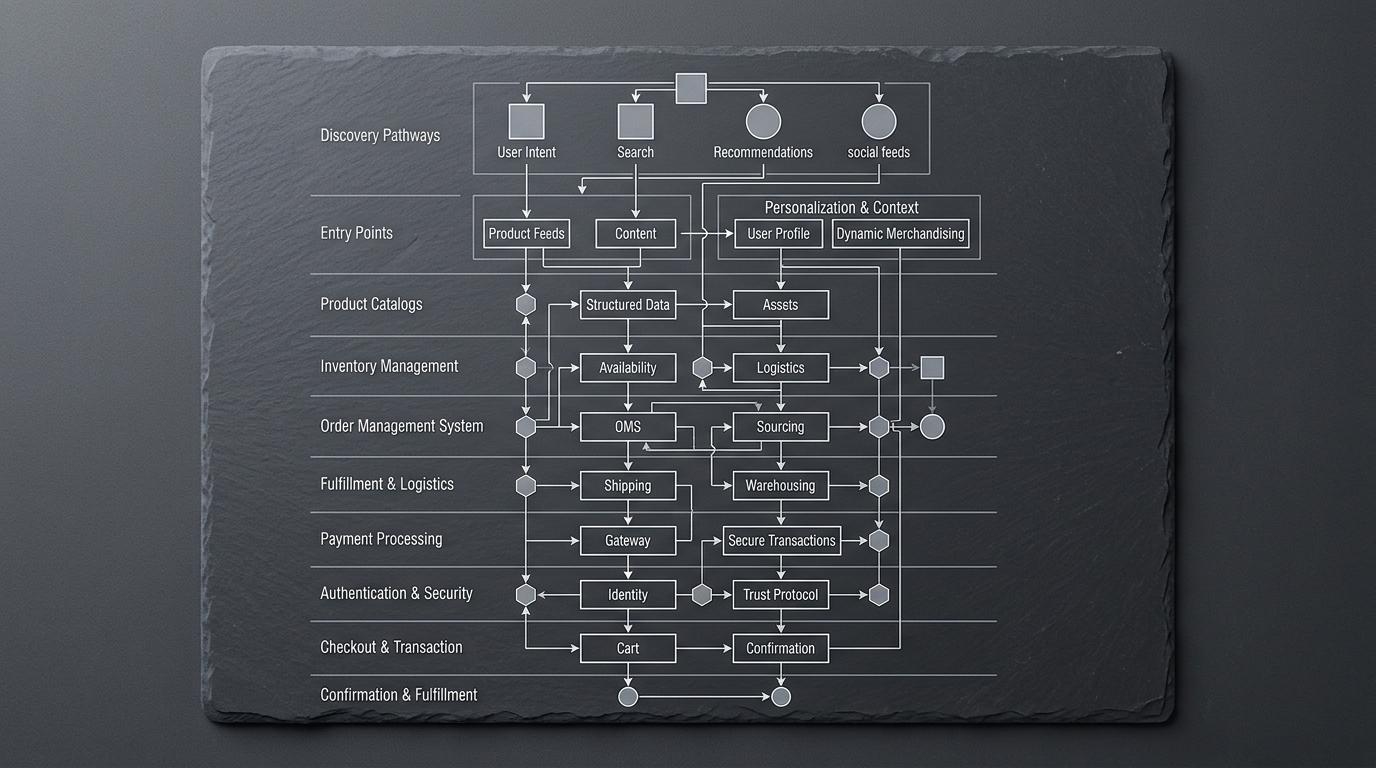
To systematically diagnose and improve AI search visibility, commerce leaders must operationalize a multi-stage framework called The AI Discovery Funnel. The funnel spans nine technical and operational gates, beginning with foundational data architecture and progressive trust validation. When an AI model processes a prompt like "best durable waterproof hiking boots under 150 dollars for wide feet," it executes a multi-step retrieval and filtering process that weeds out unstructured or ambiguous product listings.
The first four stages of The AI Discovery Funnel establish whether a product is interpretable and credible enough for machine consideration:
- Stage 1: Machine-Readable Product Data. Clean, complete JSON-LD markup and Open Graph metadata must describe technical specifications, materials, sizing, and variant identifiers without requiring client-side JavaScript rendering.
- Stage 2: Entity Clarity. The brand and product must be unambiguously mapped to recognized Knowledge Graph entities, distinct product codes (GTIN, MPN), and verified merchant identities.
- Stage 3: Product Authority. The catalog item requires corroboration across neutral third-party publishers, technical spec databases, and industry benchmark roundups.
- Stage 4: Trust Signals. Clear warranty disclosures, customer service access points, and unambiguous security protocols must be easily extracted by crawler bots.
Building trust and structured data pays direct commercial dividends. Shopify has reported that AI-referred shoppers convert at nearly 50% higher rates than organic search visitors, with average order values around 14% higher, driven by the intense pre-qualification that occurs inside conversational interfaces. AI models systematically prioritize catalogs that present structured, verifiable facts over those relying on promotional marketing copy.
The AI Discovery Funnel: Eligibility and Readiness
Once an ecommerce catalog establishes baseline data structure and entity trust, it enters the second half of The AI Discovery Funnel. Stages 5 through 9 govern whether the generative engine can actively cite, recommend, and execute a purchase for the consumer. In conversational commerce, incomplete operational data causes instant disqualification because an AI assistant will not risk recommending an out-of-stock item or an incorrect price.
The final five stages complete the discovery pathway:
- Stage 5: Availability and Price Accuracy. Real-time API feeds and consistent merchant center feeds ensure zero latency between live inventory, currency-adjusted pricing, and crawler caches.
- Stage 6: Reviews and Evidence Extraction. Verifiable, user-generated reviews containing specific dimensional feedback (fit, durability, real-world performance) provide the qualitative evidence models need for synthesis.
- Stage 7: Structured Comparison Compatibility. Attribute tables and standardized comparison metrics allow the LLM to benchmark the product directly against competing alternatives across exact user constraints.
- Stage 8: Citation and Recommendation Eligibility. The product profile satisfies the model's internal confidence thresholds for relevance, factual consistency, and neutral authority.
- Stage 9: Transaction Readiness. Machine-readable checkout endpoints, standardized payment gateways, and explicit shipping matrices allow autonomous agents to complete or initiate the purchase.
As consumer adoption of AI-assisted shopping deepens, maintaining real-time data feeds becomes an operational prerequisite. When autonomous agents evaluate catalogs, missing return policies or ambiguous shipping costs drop a product from recommendation consideration entirely.
What information does an AI agent need before recommending a product?
An AI agent is fundamentally risk-averse when formulating buying advice. Because conversational engines aim to deliver accurate, defensible solutions to user queries, they require comprehensive data points across multiple operational dimensions before putting a product forward. If an agent cannot determine compatibility, warranty terms, or return policies, it defaults to a competitor whose data is fully transparent and verifiable.
The rapid expansion of AI answer modules underscores this requirement. A Visibility Labs study of 20.9 million shopping keywords found that Google AI Overviews now appear on 14.0% of shopping queries, up from 2.1% four months earlier. Omitting critical product data directly eliminates a brand from these high-visibility placements.
Ecommerce leaders must audit their product detail pages against an explicit evidence checklist to ensure total agent readability:
- Exact Technical Attributes: Explicit dimensions, weight, materials, color codes, capacity, and power specifications formatted in structured tables.
- Specific Use Cases: Clear definitions of intended environments, skill levels, weather conditions, and operational limits.
- Live Pricing and Currency: Unambiguous base prices, regional currency support, volume discounts, and active promotional terms.
- Stock Availability: Real-time stock status, fulfillment location data, and replenishment schedules.
- Shipping and Delivery Schedules: Estimated transit times, carrier options, regional restrictions, and expedited delivery fees.
- Compatibility Matrices: Direct mapping of compatible accessories, hardware configurations, operating systems, and replacement parts.
- Return and Warranty Policies: Exact return windows, restocking fees, prepaid label availability, and coverage limitations.
- Third-Party Evidence and Reviews: Aggregated star ratings, verified buyer badges, sentiment distributions, and quotes from independent testing labs.
- Merchant Trust Indicators: Business registration details, physical address, customer support channels, and data privacy disclosures.
Conversely, common red flags that immediately disqualify products from AI recommendations include hidden shipping fees, contradictory pricing across schema and visible text, client-side JavaScript-rendered specs that bots cannot crawl, vague promotional claims lacking numeric substantiation, and missing return policies.
Executive Implications and Decision Questions
The transition toward AI-mediated product discovery introduces significant strategic risks for brands that cling solely to legacy SEO playbooks. Relying purely on traditional keyword volume metrics blinds leadership to the growing share of conversational discovery occurring in zero-click and synthesized environments. When competitors optimize their product graphs for LLM extraction, they capture high-intent buyers earlier in the consideration cycle.
Evaluating an organization's readiness for conversational commerce requires executive teams to apply a rigorous strategic decision-making framework that balances content engineering, catalog data infrastructure, and brand reputation management.
- Are our product attributes exposed as server-rendered, structured schema that AI web crawlers can ingest without JavaScript execution?
- How frequently does our brand appear in conversational shopping recommendations for our top non-branded category queries?
- Do our public support resources, help centers, and product FAQs clearly provide the factual evidence large language models need to verify product claims?
- Are our inventory feeds, return rules, and shipping matrices synchronized in real time across search and agentic shopping endpoints?
- What proportion of our digital discovery strategy is currently allocated to Generative Engine Optimization relative to legacy keyword tracking?
Failing to address these questions leaves an ecommerce enterprise vulnerable to silent market share erosion. As conversational assistants take on a larger share of pre-purchase research, visibility shifts to brands that make their value propositions mathematically clear and factually undeniable.
Executing the Workflow and How Decisity Supports It
Adapting an ecommerce enterprise for AI-mediated discovery requires a repeatable workflow that bridges catalog engineering, knowledge management, and executive strategy. Growth leaders must first run automated audits of their product schemas, ensuring that all technical attributes, compatibility rules, and policies are completely machine-readable. Next, marketing teams should transform static marketing copy into evidence-backed, factual documentation that directly answers complex user queries.
Connecting your public documentation and help infrastructure to a single source of truth ensures that external AI search engines find consistent, verified data across every query. Maintaining structured help centers and transparent customer support documentation allows AI crawlers to cite authoritative brand facts rather than hallucinating outdated policies or third-party rumors.
Executing this multi-layered transformation requires cross-functional alignment between merchandising, technical SEO, and executive leadership. Modern strategy teams deploy Decisity to structure enterprise transformation roadmaps, analyze competitive market shifts, and build board-ready execution plans that align digital infrastructure with emerging commercial channels. By leveraging dedicated digital and AI strategy solutions, leadership teams can systematically evaluate their visibility gaps, prioritize technical investments, and maintain competitive dominance as AI becomes the primary interface for digital commerce.