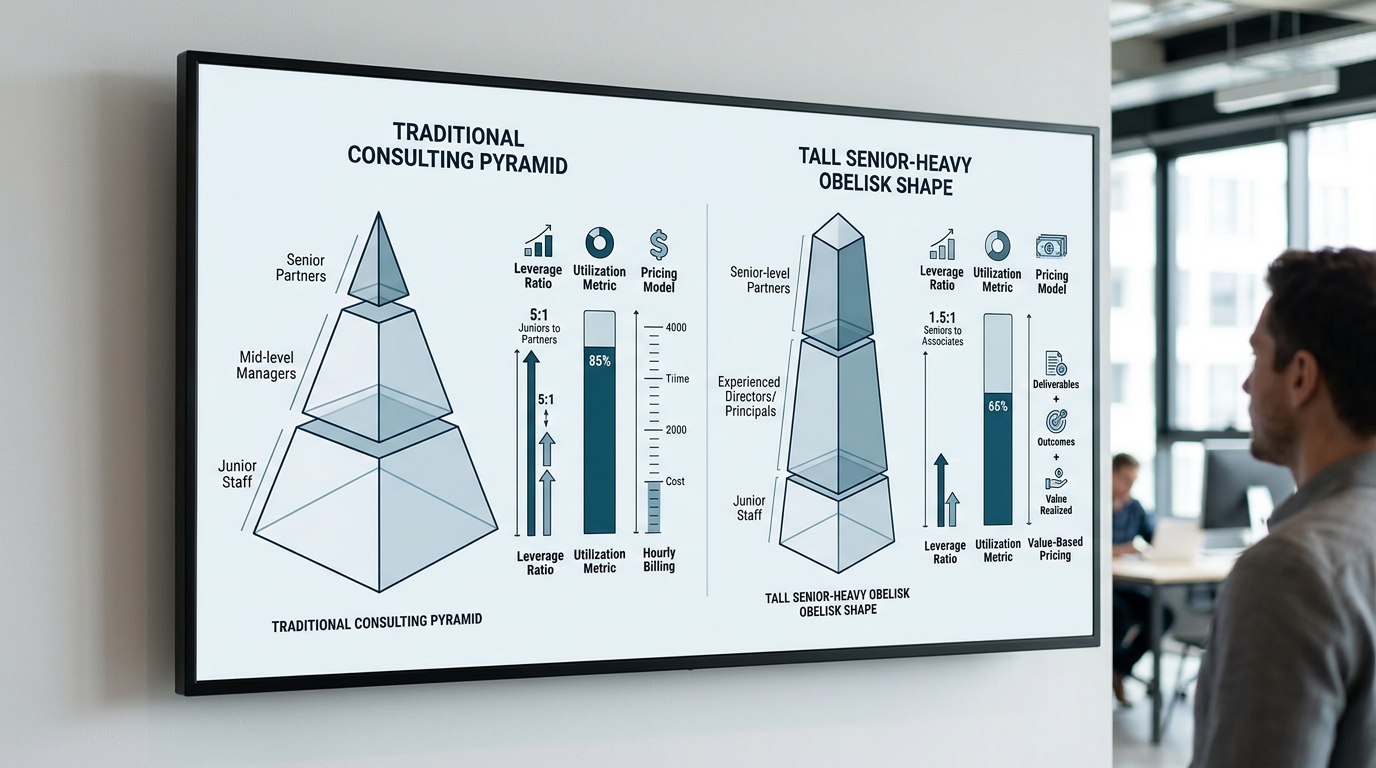
The pyramid math: how junior leverage built firm economics
Every classic consulting P&L runs on one identity. Partners sell and supervise. A wide junior base bills premium rates for research, modeling and first drafts. Profit per partner is a function of three levers: the rates you charge, the leverage ratio of juniors per partner, and the utilization of every billable body in between. The engine's core margin source is the spread between what a junior costs and what a junior bills, multiplied across hundreds of analysts. The pyramid, in other words, was never primarily an org chart. It was a margin machine that stacked cheap labor under expensive brains[1].
- Rates: the premium price a brand can command per hour, set at the top of the relationship and applied to every layer beneath it.
- Leverage: the number of juniors per partner. More juniors per partner means each senior hour of sold expertise bills many junior hours behind it.
- Utilization: the share of each employee's time that turns into billable hours. High utilization converts fixed salary into flowing revenue.
The pyramid also hid a second system inside the first. Juniors learned by producing: the apprenticeship that eventually manufactured senior judgment was funded by client billing, hour by hour. And because growth meant adding clients, and clients meant analysts, scale in headcount became the growth model. A firm grew by hiring more of the base, not by getting more from the top.
That engine depended on two assumptions: that structured work had to be done by humans, and that clients would keep paying by the hour for it. Both are now dissolving, and every lever in the model is moving at once.
AI leverage replaces the bottom of the pyramid
Specialist AI agents now absorb the work that filled junior weeks: structured evidence gathering, document cross-referencing, modeling, and the first draft of the deliverable. This converts labor-based leverage into technology-based leverage. The bottom of the pyramid does not disappear because juniors fail; it compresses because the tasks that justified it are no longer scarce.
| Signal | What the data shows |
|---|---|
| McKinsey's Lilli platform | 72% of the firm active since the July 2023 rollout, with colleagues reporting up to 30% time savings in searching and synthesizing knowledge |
| Consultant hiring vs 2023 peak | Demand for consultant roles is about 40% below its 2023 peak, while overall hiring is roughly 20% below |
| AI roles vs entry-level consultants | By 2025, AI roles outnumber entry-level consultants at top firms, having reversed a ratio that stood near four junior consultants per AI role in 2015 |
| Entry-level pay | Major firms including McKinsey, BCG and Bain have frozen starting salaries for the third consecutive year as AI reshapes the junior-heavy pyramid model |
The broader restructuring is real but should be read soberly. PwC has abandoned a headcount target set before generative AI's rollout as revenue growth slows[5], and there have been reports of restructuring within KPMG's advisory business as demand shifts across service lines[6]. The economic story is not collapse. It is a repricing of the junior base: the tasks at the bottom of the pyramid are being repriced toward zero, and firms are adjusting the base accordingly.
Why the top of the pyramid gets more valuable
As synthetic labor takes the base, the top appreciates. Revelio Labs data shows demand for senior consultants has risen 55% since 2020, even as entry-level consultant hiring fell 10% after its 2023 peak[3]. Firms are not buying less expertise. They are buying a different kind: oversight, interpretation and contextualization of increasingly automated processes.
The client side explains why. When research and first drafts are near-free, clients stop paying for decks and process and start paying for decisions and outcomes. That is the judgment premium: the scarcity rent that accrues to people who can frame the problem, pressure-test the answer and carry it through a client's politics. Analysis of this shift argues that AI commoditizes analytical output while driving up the value of exactly this human judgment.
- Build deep sector expertise first, often inside the industry itself, because that depth is what clients can no longer synthesize on their own.
- Move into consulting with judgment as the entry ticket, not production capacity.
- Progress by widening the scope of decisions owned, not the size of teams managed.
For firm economics, the implication is direct: in an AI-era market, a partner-heavy firm with real sector depth can charge for scarcity, while a headcount-heavy firm is exposed wherever its value still lives in the base.
The AI-Era Leverage Model: seven rungs from problem to outcome
To manage this shift deliberately rather than reactively, it helps to name it. The AI-Era Leverage Model describes an engagement as seven rungs, each mapping to one economic decision a partner actually makes. Where the old model treated leverage as a staffing ratio, this model treats it as a chain of choices that runs from the client's problem to the outcome that gets measured.
| Rung | The economic decision it governs |
|---|---|
| 1. Client problem | What outcome is the client actually buying, and how will it be measured? |
| 2. AI leverage | Which structured evidence gathering, modeling and first-draft work is delegated to specialist agents? |
| 3. Human judgment | Where must interpretation, framing and client trust remain human because delegation would destroy value? |
| 4. Expert depth | Which sector or functional expertise commands the premium and cannot be synthesized from public sources? |
| 5. Delivery team shape | What pod size and seniority mix does the work actually require once agents carry the base? |
| 6. Pricing model | Does this engagement price as time, as fixed scope, or as an outcome, and what risk does each transfer? |
| 7. Outcome | What evidence proves value was delivered, and what does that evidence justify on the next engagement? |
The contrast that matters is between AI leverage and headcount leverage. Headcount leverage scales linearly with hiring, breaks whenever utilization dips, and trains slowly. AI leverage scales with agent capacity, compounds as workflows are reused across engagements, and costs marginal amounts to extend. The rungs keep expert depth explicit as the human premium: rungs two and three force you to decide what the agents take, and rung four forces you to name the expertise that justifies the fee once they have taken it.
Used as a diagnostic, the model exposes where a legacy engagement leaks: firms that delegate at rung two but still price at rung six by the hour are donating their efficiency gains to the client one billing cycle at a time.
Utilization targets and staffing for augmented workflows
Utilization math built on billable junior hours breaks the moment agents deliver in hours what took junior weeks. If a first draft takes an afternoon instead of two weeks, an hours-per-FTE target either punishes the efficiency or forces the firm to pretend the hours happened. The metric has to move from hours per FTE to throughput per expert: the value of engagements delivered per senior, with agent capacity counted as leverage rather than as labor.
| Team shape | Leverage source | Economic implication |
|---|---|---|
| Pyramid | Wide junior base billing premium rates | Margins exposed as AI compresses the billable hours the base exists to fill |
| Obelisk | Senior experts amplified by AI, with almost no junior base: the shift toward an obelisk structure some analysts describe | Highest margin per expert, but capacity is capped by partner time and the apprenticeship pipeline thins |
| Diamond | A strong middle of architects and specialists, a thin AI-augmented base, a small partner apex | Balances technology leverage with a preserved training pipeline; the pragmatic bet for most firms |
- Staff engagements as small, senior-heavy pods, typically three to five people, sized to the decision being made rather than the hours being filled.
- Name an AI facilitator on every pod whose job is designing and supervising the agent workflows, not producing the deck.
- Recompute the leverage ratio as value delivered per senior, with agent capacity as the multiplier, and retire juniors-per-partner as a management metric.
- Protect a thin apprenticeship layer deliberately, because the diamond's middle cannot be grown if no one ever starts at the base.
Pricing shift: from time-and-materials to outcome-linked fees
The pricing economics follow directly. When cost-to-serve falls faster than price, margin widens. But that widening is a temporary arbitrage, not a permanent gift: clients can see the efficiency, and procurement is already asking firms to explain how they are applying AI[1]. Sooner or later clients demand a share of it, and the firms that move first get to set the terms on which it is shared.
Run the arithmetic on a typical engagement and the paradox is obvious. A ten-week project delivered in six weeks cuts the delivery cost base by roughly 30-40%, while a time-anchored fee either stays the same, handing the firm a windfall the client will claw back at renewal, or falls, handing the gain back immediately. Either way, hours stop being a defensible basis for the fee. This is what makes outcome-linked and value-linked pricing economically rational rather than idealistic: it prices the decision, not the document.
The market is already moving. BCG's CEO says three quarters of the firm's largest AI cases now run under variable-fee arrangements tied to client goals such as lower costs or higher revenue growth[7]. For most firms, the workable structure is not pure gain share but a base fee that reflects reduced execution risk, plus outcome metrics layered on top, a combination unpacked in the guide to outcome-based consulting.
- Set a base fee on scope and complexity, reflecting that agents have removed most execution risk, not on estimated hours.
- Attach one to three outcome metrics drawn from rung one of the AI-Era Leverage Model, with measurement agreed before the work starts.
- Make AI use and source traceability part of the pitch, because clients now treat explainable process as a credential.
- Reserve upside for verified outcomes, so the firm keeps a share of the efficiency it created rather than donating it.
Training, progression and margin in the augmented firm
The quiet casualty of the compressed pyramid is the pipeline that built it. The apprenticeship that produced senior judgment ran through junior production: juniors learned to judge by doing the work agents now do. If progression is left on autopilot, the augmented firm will discover in a decade that it has partners and no way to make more of them. Progression has to be rebuilt around AI facilitation and applied judgment from day one, a restructuring of the consulting apprenticeship rather than an add-on to it.
- AI facilitator: runs and improves the agent workflows, learns to evaluate output quality rather than produce volume.
- Engagement architect: frames problems, designs the division of labor between agents and humans, owns delivery.
- Client leader: owns the relationship, the judgment premium and the outcome, priced on rung six of the model.
The margin implications cut both ways. Senior-heavy teams carry a higher cost per expert, so the augmented firm's margin survives only if throughput per expert rises with it and pricing follows the outcome rather than the hours. Firms that keep time-and-materials pricing while their cost base collapses will watch clients capture the entire gain.
This is the workflow Decisity is built around: an AI-native strategy platform that partners use to structure client engagements end to end, from document ingestion through MECE-structured, fully traceable deliverables, so the augmented pod works from evidence rather than improvisation. The deeper question underneath it, whether AI replaces the consultant or re-prices the firm, is unpacked in a dedicated comparison of AI vs management consultants[8], and firms advising clients across markets can see how the platform supports advisory firms working at international reach. The firms that win the next decade will not be the ones with the most agents. They will be the ones that redesigned leverage, staffing and price around them first.
For a complementary lens on how these choices reshape the wider organization of the firm, see the separate piece on consulting operating model redesign, which covers the structural questions this article deliberately leaves to one side.
Related: AI vs management consultants.