Defining the Future of Strategy Consulting
The future of strategy consulting is defined by a structural transition from manual data aggregation and slide production to AI-assisted problem solving, rapid scenario modeling, and evidence-traceable decision support. Artificial intelligence does not replace professional judgment or strategic foresight; rather, it automates context collection, hypothesis generation, and preliminary analysis. This shift allows management consultants and executive teams to focus on problem framing, tradeoff evaluation, and stakeholder alignment. By embedding artificial intelligence into core strategy workflows, organizations compress research timelines from weeks to hours while elevating the depth and rigor of executive decisions.
Historically, corporate strategy engagements devoted a large share of billable hours to preliminary data collection, market research synthesis, and manual deck formatting. Modern generative models and structured reasoning engines automate these labor-intensive activities. Forward-thinking advisory organizations therefore treat artificial intelligence as a catalyst across market analysis, M&A due diligence, and digital transformation strategy, using the time recovered from synthesis work to concentrate on strategic positioning and risk management.
The Paradigm Shift in Strategy Advisory
To navigate this evolving environment, executive leaders and strategy buyers must understand how traditional advisory models contrast with emerging AI-assisted workflows across key operational dimensions.
- Data Gathering: Traditional models rely on manual desk research and interview transcription; AI-assisted workflows leverage automated document ingestion and structured semantic search.
- Hypothesis Testing: Traditional approaches iterate hypotheses sequentially through manual analysis; modern platforms enable parallel scenario modeling and stress testing.
- Deliverable Creation: Traditional consulting produces static slide decks over multi-week cycles; AI-native methods generate source-traced, board-ready presentations with transparent audit trails.
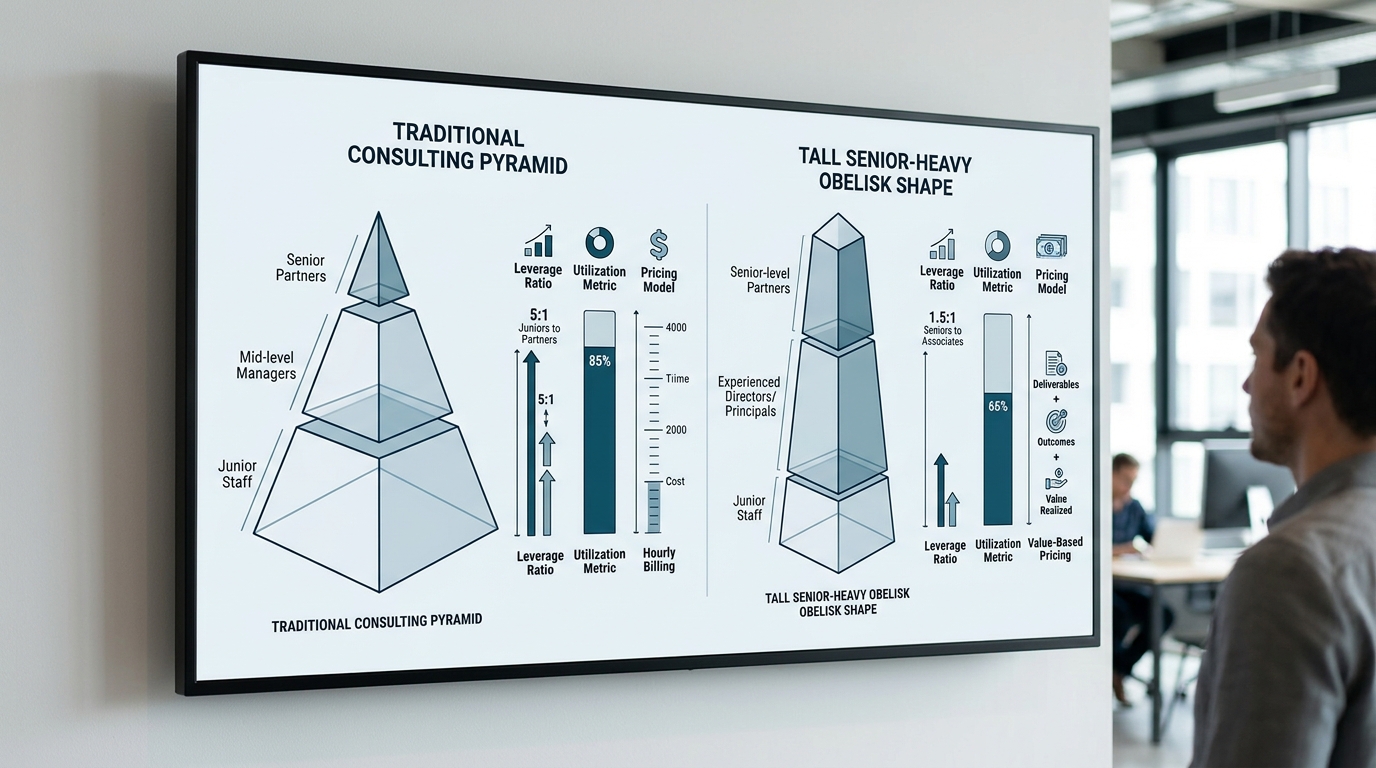
- Value Focus: Traditional billable hours reward time spent on process; AI-enabled advisory rewards speed of insight, decision quality, and execution alignment.
As corporate advisory models adapt, organizations seeking specialized external support increasingly evaluate modern AI strategy advisory capabilities to maintain competitive momentum.
Related read: the Decisity platform and how it works.
Why the Shift to AI Matters Now
The acceleration of artificial intelligence in strategic management is no longer a theoretical forecast; it is demonstrated by major industry gatherings and public strategy forums scheduled for September 2026 in Berlin. Events such as Boston Consulting Group's Future-Forward Thinking conference (Berlin, 10-11 September 2026), the BIG BANG KI Festival at STATION Berlin (16-17 September 2026), and Roland Berger's strategic partnership at the WELT AI Summit (Berlin, 21-22 September 2026) signal that enterprise AI integration has reached the top of the C-suite agenda.
These events reflect a broader industry realization: artificial intelligence is not merely a software utility for back-office automation, but the core engine for strategic problem solving and growth analysis. The BIG BANG KI Festival alone expects over 11,000 attendees and 350 speakers across five stages, highlighting the scale at which corporate decision-makers are aligning around AI-driven innovation and operational execution.
Industry Event Signals in Late 2026
| Event Signal | Date & Location | Strategic Focus for Advisory |
|---|---|---|
| BCG Future-Forward Thinking | 10-11 September 2026, Berlin | Deploying generative AI tools across enterprise workflows and reshaping operating models. |
| BIG BANG KI Festival | 16-17 September 2026, Berlin | Applying practical AI frameworks to medium-sized business strategy and digital transformation. |
| WELT AI Summit Partnership | 21-22 September 2026, Berlin | Aligning executive leadership, macroeconomics, and European competitiveness through AI. |
These public signals demonstrate that consulting clients and corporate strategy departments are moving beyond experimental pilots. Decision-makers now demand rigorous executive decision frameworks that integrate quantitative data, strategic reasoning, and traceable sources into executive recommendations.
A Practical Framework for Human-AI Collaboration
To successfully capture the benefits of artificial intelligence without exposing the enterprise to operational risk, leading strategy consultancies utilize structured operational frameworks. Boston Consulting Group applies a three-stage model for enterprise transformation: Deploy, Reshape, and Invent. This framework offers a clear path for strategy leaders seeking to modernize internal capabilities.
The Deploy-Reshape-Invent (DRI) Model
- 1. Deploy: Distribute general-purpose AI tools across existing workflows to establish enterprise fluency and generate initial productivity gains (typically 10-15 percent efficiency improvements).
- 2. Reshape: Redesign core organizational structures, business processes, and strategy workflows around AI capabilities, turning temporary time savings into sustained operating margin expansion.
- 3. Invent: Build novel AI-native products, service offerings, and competitive business models that alter the market dynamics of the industry.
The financial expansion of major consultancies underscores this structural migration. Roland Berger generated revenues of 1.01 billion euros in 2025, the strongest year in the firm's history, with growth driven by projects focused on AI implementation, digital transformation, operational performance improvement, and supply chain optimization. Across the advisory landscape, demand of this kind shows that enterprise clients actively seek structured guidance on human-plus-AI collaboration.
When applied to strategy consulting, human-AI collaboration ensures that machine speed handles data synthesis while executive human judgment retains authority over resource allocation, risk appetite, and final decisions. Adopting formalized transformation strategy frameworks ensures that AI initiatives transition seamlessly from board ambition to measurable execution.
Key Decision Questions for Executives
As corporate boards and strategy leaders evaluate AI-driven advisory tools and external consultants, rigorous governance is paramount. A Deloitte survey of 3,235 information technology and business leaders from 24 countries found that only a minority say their organizations have a mature governance model in place for agentic AI, leaving roughly 80 percent without clear decision boundaries, real-time monitoring, or audit trails for agent actions.
To prevent strategic drift and ensure accountability, consulting buyers and C-suite executives must ask specific, probing questions before committing capital or deploying AI models into strategic planning processes.
C-Suite Evaluation Checklist
| Evaluation Domain | Critical Decision Question | Target Standard |
|---|---|---|
| Governance & Oversight | Does the platform or advisory firm maintain explicit human-in-the-loop controls for all strategic outputs? | Complete human oversight with documented review steps before board presentation. |
| Source Traceability | Can every statistic, market size figure, and competitor quote be verified against primary documents? | Direct citation linkage to original data sources without opaque model outputs. |
| Risk Mitigation | How are hallucinations, bias, and unauthorized data leakage prevented during research? | Strict data privacy protocols and deterministic grounding in verified knowledge bases. |
| Skill Alignment | Are internal strategy teams trained to conduct rigorous strategic problem framing alongside AI engines? | Formal upskilling programs covering prompt engineering, hypothesis structuring, and validation. |
Evaluating these dimensions protects executive leadership from relying on unverified assumptions during critical growth or restructuring decisions.
AI Adoption Checklist and Warning Red Flags
When integrating artificial intelligence into strategic planning, decision-makers must distinguish between substantive reasoning platforms and superficial marketing hype. Generic future-of-work filler and unverified AI claims introduce severe risk into strategic options analysis.
Strategy Team AI Readiness Checklist
- Problem Structuring: Ensure problems are framed using mutually exclusive and collectively exhaustive (MECE) issue trees before running AI queries.
- Source Verification: Confirm that every AI-generated claim links directly to a verifiable primary source, document, or dataset.
- Security & Privacy: Verify that enterprise strategy data is strictly hosted in compliant environments with zero external model training on proprietary inputs.
- Human Judgment Protocol: Enforce formal executive review steps for all strategic trade-offs and capital allocation decisions.
- Governance Integration: Align AI workflows with corporate risk management, legal oversight, and auditability standards.
Warning Red Flags in AI Consulting
| Warning Red Flag | Operational Risk | Corrective Standard |
|---|---|---|
| Autonomous Decision Proposals | AI platforms suggesting autonomous capital allocation without executive review. | Enforce strict human-in-the-loop decision boundaries. |
| Black-Box Recommendations | Strategic options presented without direct citations or underlying source documents. | Require source-traced reasoning for every analytical claim. |
| Generic Future-of-Work Hype | Vague assertions regarding productivity without concrete workflow benchmarks. | Demand quantitative efficiency and decision-quality metrics. |
| Unstructured Search Outputs | Aggregated web summaries that ignore internal strategic context and market nuances. | Ground research engines in validated enterprise knowledge bases. |
By applying strict audit standards and rejecting black-box systems, leadership teams ensure that AI adoption elevates strategic rigor while mitigating operational exposure.
How to use this in your next workflow
Translating the future of strategy consulting into daily operations requires a repeatable, four-step methodology. Strategy teams and internal consultants can implement this workflow to accelerate market research, evaluate digital use cases, and deliver board-ready outputs.
Step-by-Step Strategic Execution Workflow
First, initiate strategic problem framing by defining clear business questions and establishing MECE issue trees. Avoid vague queries; ground the initial scope in specific corporate objectives, target markets, or operational constraints.
Second, execute evidence-led market and competitive analysis by ingesting primary documents, financial filings, and industry reports into an AI-assisted research engine. Extract verified statistics, evaluate competitor positioning, and synthesize core findings in parallel.
Third, conduct strategic options analysis to stress-test hypotheses. Use structured reasoning to weigh trade-offs, evaluate digital use-case prioritization, and model downside risks under alternative macroeconomic scenarios.
Fourth, assemble board-ready presentation deliverables characterized by structured action titles, source-traced footnotes, and clear executive recommendations.
How Decisity supports the workflow
Decisity is an AI-native strategy platform developed by CITO GmbH for executive leaders, strategy departments, and management consultancies. Built specifically for complex advisory workflows, it combines structured strategic reasoning, scope framing, and competitive analysis into a unified, source-traced environment.
By automating data ingestion, semantic search, and document synthesis, the platform shortens research timelines while maintaining source auditability. Strategy teams use it to draft MECE issue trees, prioritize digital and AI use cases, and generate board-ready presentations with footnoted source links for every analytical claim.
The platform is designed strictly to support and enhance professional human judgment. It does not make autonomous corporate decisions, provide legal or regulated advice, or replace C-suite responsibility. Instead it acts as a support layer for strategic analysis, ensuring that human leaders retain full authority over resource allocation and strategic direction.
Through structured workflow management and strict data privacy, the platform bridges the gap between executive intent and execution. Organizations seeking to modernize their advisory capabilities can explore how AI-native strategy consulting platforms transform complex briefs into verifiable strategic roadmaps, while implementing robust strategy execution frameworks to support measurable business value.