Management Consulting Trends 2026: Definition and Core Shifts
Management consulting trends 2026 reflect a fundamental operational shift in how strategy is formulated, validated, and delivered. Driven by generative AI and agentic workflow integration, the consulting landscape has transitioned from manual document synthesis and static presentation decks toward automated evidence cycles, continuous strategic planning, and highly specialized advisory teams. Modern advisory engagements combine real-time market data ingestion with rigorous human reasoning, enabling corporate decision-makers to test strategic hypotheses in days rather than months while maintaining complete auditability across every analytical output.
To understand this transformation, executive leaders and strategy buyers must evaluate seven core operational shifts currently reshaping corporate advisory engagements:
- AI-Supported Research and Synthesis: Automating secondary research and document analysis to free consultants for strategic problem framing.
- Agentic Workflows: Deploying specialized task-specific agents that execute complex multi-step research and data modeling under human supervision.
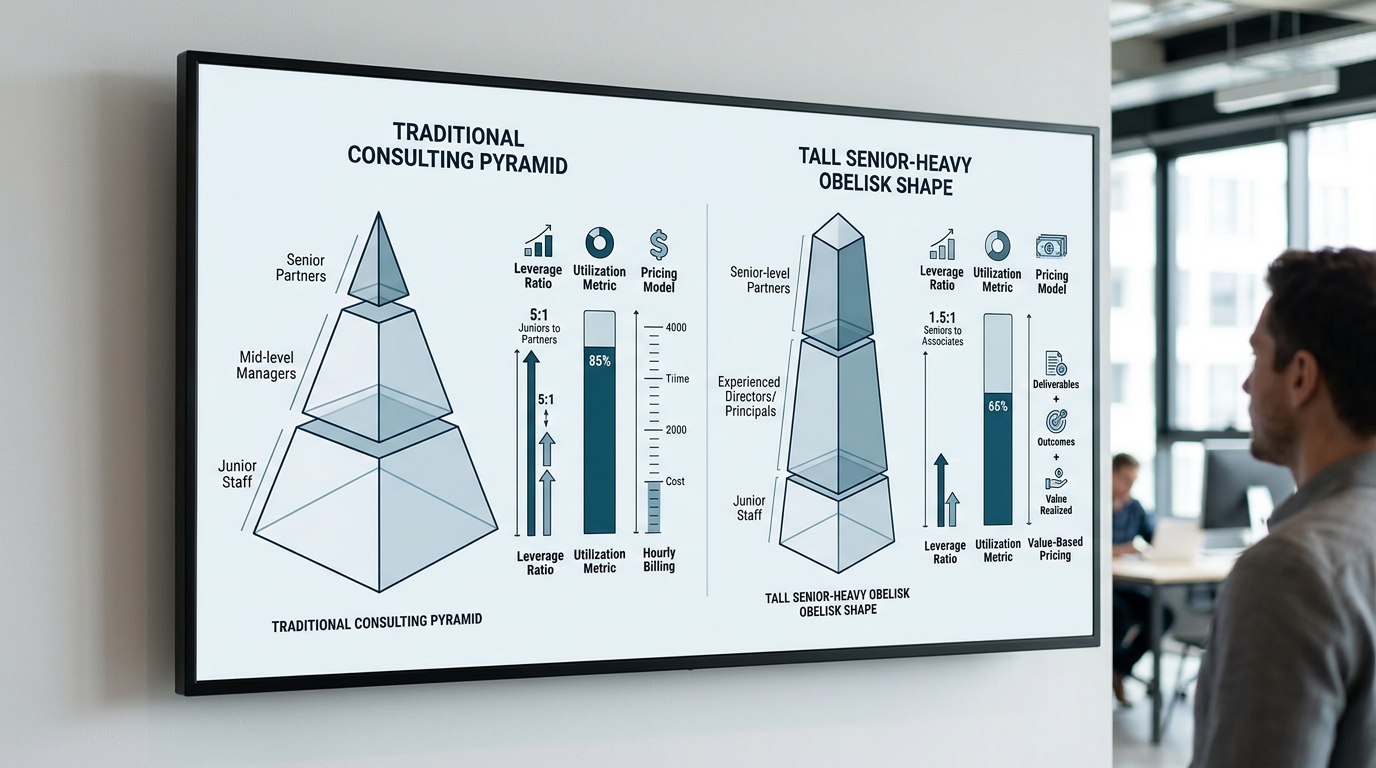
- Smaller, High-Leverage Teams: Replacing massive analyst pyramids with lean consulting pods capable of managing enterprise-scale scopes.
- Technical-Plus-Consulting Hybrids: Integrating data engineering and machine learning capabilities directly into strategic advisory roles.
- Faster Evidence Cycles: Shifting from billable-hour time-and-materials structures to rapid evidence delivery and outcome-aligned engagements.
- Continuous Strategy Frameworks: Transitioning from static annual slide decks to living, dynamically updated strategic roadmaps.
- Source Traceability and Auditability: Enforcing strict provenance standards where every metric and factual assertion links directly to primary sources.
Adoption is no longer experimental: a majority of large advisory firms now run AI-supported research and synthesis inside live client delivery rather than in isolated internal pilots. This evolution enables AI-native strategy consulting models to compress project timelines while significantly reducing administrative overhead.
| Shift | Legacy Consulting Practice (Pre-2026) | Modern Strategic Model (2026+) |
|---|---|---|
| Research & Synthesis | Manual secondary research and manual slide drafting | Automated document ingestion with AI-supported research and real-time synthesis |
| Workflow Execution | Linear human analysis across junior analyst pools | Agentic workflows executing parallel research tasks under expert oversight |
| Team Structure | Large pyramid teams with high analyst-to-partner ratios | Compact, high-leverage teams with hybrid technical skills |
| Billing & Value | Time-and-materials pricing based on billable hours | Outcome-oriented models linked to rapid evidence delivery |
| Strategy Cadence | Static annual or bi-annual slide deck updates | Continuous strategy models with dynamic scenario updates |
| Source Auditability | Opaque footnotes and untraceable desk research | Granular traceable source citations for every factual claim |
| Advisor Profile | Generalist management consultants | Technical-plus-consulting hybrids combining domain depth and data capability |
Why This Matters Now: Agentic Workflows and Faster Evidence
The shift toward modern consulting models is accelerated by macroeconomic volatility and rapid technological maturity. Enterprise clients no longer accept multi-month discovery phases that yield static observations. Instead, executive teams demand rapid, verifiable evidence to validate capital allocation decisions in dynamic market conditions.
Agentic workflows are central to this acceleration. Rather than acting as simple conversational assistants, task-specific AI agents ingest corporate documents, execute financial checks, synthesize competitive benchmarks, and draft structured analytical modules. Microsoft's Work Trend Index survey of 31,000 workers found that 81% of leaders expect agents to be moderately or extensively integrated into their company's AI strategy in the next 12 to 18 months. Gartner predicts that 40% of enterprise applications will be integrated with task-specific AI agents by the end of 2026, up from less than 5% at the time of its August 2025 forecast.
By collapsing research cycles from weeks to hours, consulting teams can devote the majority of their billable engagements to high-value problem framing, scenario evaluation, and executive alignment. This transition enables strategy leaders to rely on executive decision frameworks anchored in real-time market data rather than lagging assumptions.
- Rapid Hypothesis Validation: Testing strategic assumptions against live market data within 48 hours of project kick-off.
- Elimination of Low-Value Formatting: Automating slide alignment, chart rendering, and source footnote formatting.
- Transparent Evidence Provenance: Maintaining verifiable audit trails from raw source documents to final executive summary slides.
The Continuous Strategy Framework: A Practical Model
To replace static annual presentations, forward-thinking strategy organizations are adopting the Continuous Strategy Framework. This practical model structures strategy work into an ongoing cycle of evidence collection, hypothesis refinement, and board-level decision readiness.
Core Architecture of Continuous Strategy
The Continuous Strategy Framework consists of four interconnected operational layers:
- Continuous Evidence Ingestion: Automated tracking of market shifts, competitor regulatory filings, and internal operational metrics.
- Dynamic Hypothesis Testing: Evaluating strategic options against live data streams to validate or pivot strategic direction rapidly.
- Modular Deliverable Assembly: Maintaining living presentation modules that instantly render into board-ready strategy decks.
- Governance and Human Verification: Ensuring experienced partners review every analytical step and validate source lineage before executive submission.
Implementing this continuous model requires new workforce capabilities. Industry studies demonstrate that leveraging specialized AI platforms can yield up to a 49% performance improvement on complex analytical tasks outside a consultant's primary domain. However, successful execution requires preserving human judgement in advisory roles to interpret political nuance and guide strategic tradeoffs.
Decision Questions and Evidence for Consulting Buyers
Corporate buyers of management consulting services must update their procurement criteria to evaluate whether prospective partners possess genuine AI-native capabilities or merely rebrand legacy billable-hour models.
Critical Evaluation Checklist for Enterprise Buyers
When selecting consulting partners in 2026, strategy buyers should evaluate vendors against five concrete criteria:
- Source Lineage: Can the firm demonstrate explicit, auditable links between every recommendation and its underlying data origin?
- Evidence Velocity: Does the firm deliver preliminary evidence-backed hypotheses within days rather than weeks?
- Team Composition: Does the engagement team include technical-consulting hybrids capable of customizing analytical workflows?
- Tooling Architecture: Are enterprise-grade AI engines integrated directly into the firm's core deliverable pipeline?
- Dynamic Adaptability: Can deliverables be updated continuously as new market data or financial figures emerge?
Procurement leaders who ask these decision questions can effectively differentiate high-leverage strategy partners from legacy firms relying on bloated analyst rosters.
Red Flags in Outcome-Oriented Engagement Models
The US management consulting market is projected to reach $420.2 billion in 2026, driving intense competition among advisory providers. As outcome-oriented billing structures gain traction, strategy buyers must guard against exaggerated marketing claims and unverified AI tools.
| Red Flag Indicator | Vendor Claim / Surface Pattern | Underlying Risk for Consulting Buyer | Required Verification Standard |
|---|---|---|---|
| Black-Box AI Insights | We use proprietary algorithms to generate strategy roadmaps automatically. | Unverifiable claims leading to hallucinated data or flawed strategic bets. | Demand complete source traceability with clickable source links for every stat. |
| Unrealistic ROI Guarantees | Our AI strategy framework guarantees a step-change reduction in operational cost. | Premature commitments based on general industry averages rather than internal reality. | Require baseline-adjusted pilot milestones with explicit risk boundaries. |
| Generic Transformation Hype | We bring AI-driven future-of-work transformation across your entire enterprise. | Superficial buzzwords lacking tailored industry depth or technical feasibility. | Inspect concrete case studies and practical frameworks relevant to your sector. |
| Opaque Technology Surcharges | Outcome pricing covers all software licenses and agent execution fees. | Hidden software markups and misaligned engagement incentives. | Insist on clear separation between advisory service fees and software platform costs. |
How to use this in your next workflow
Applying modern consulting trends to your upcoming strategic workflow requires a structured, multi-step execution plan. Strategy leaders and advisory teams can implement these shifts immediately:
- Frame the Problem Rigorously: Define mutually exclusive and collectively exhaustive (MECE) problem boundaries before launching research activities.
- Deploy Hybrid Advisory Teams: Pair experienced strategic advisors with data specialists capable of configuring agentic research pipelines.
- Establish Lineage Standards: Require all internal strategy drafts and external advisory decks to maintain direct citations for every market stat and competitive figure.
- Adopt Iterative Evidence Sprints: Structure engagements into two-week evidence cycles, testing strategic hypotheses early and refining deliverables continuously.
- Integrate structured consulting workflows: Connect research inputs, strategic option scoring, and board presentation assembly into a unified auditable pipeline.
How Decisity supports the workflow
Decisity is an AI-native strategy platform designed for how modern strategy teams and enterprise leaders structure complex analytical work. Built around verified operational capabilities, it converts raw briefs, market research, and corporate documents into structured, board-ready deliverables while preserving complete source traceability across every slide.
The platform supports strategy leaders across critical workflow stages:
- Scope and Problem Framing: Structuring ambiguous executive questions into MECE issue trees and defined analytical workstreams.
- Market and Competitive Analysis: Ingesting structured and unstructured datasets to surface evidence-based market trends and competitor benchmarks.
- Strategic Options and Prioritisation: Evaluating strategic vectors and scoring digital or AI use cases against objective feasibility criteria.
- Evidence-Traceable Deliverables: Generating structured board-ready decks and strategy roadmaps where every factual claim links directly to its primary source.
The platform does not replace management consultants or executive judgement, nor does it make autonomous decisions or provide legal or regulated advice. Instead, it equips strategy professionals with a structured workflow engine that accelerates research cycles, enhances analytical precision, and keeps every strategic recommendation auditable.