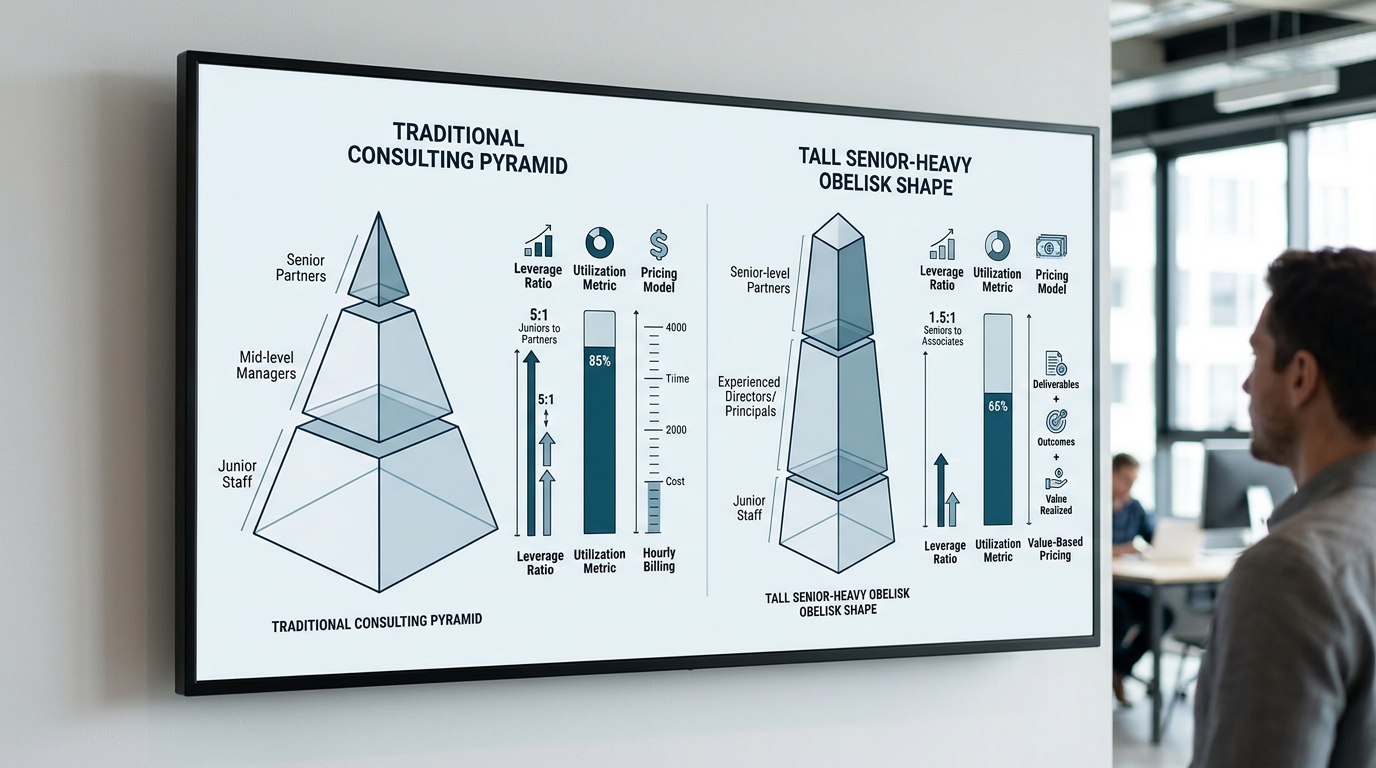
What Is Outcome-Based Consulting?
The outcome-based consulting model is a commercial approach in management advisory where project fees are tied directly to predefined, quantifiable business results rather than the volume of time spent or labor inputs consumed. Under this framework, compensation is contingent upon achieving explicit operational, financial, or strategic milestones, such as realized cost reductions, revenue growth, or accelerated system deployments. By aligning financial remuneration with verifiable impact, outcome-based pricing shifts commercial risk from the client to the consultancy, creating a shared-incentive architecture that rewards efficiency, execution precision, and measurable value creation instead of prolonged engagement hours.
For decades, management consulting has operated under traditional time-and-materials logic. Under that legacy model, clients purchased consultant hours, paying for time worked regardless of whether the strategic advice yielded tangible business improvements. As management author David Maister famously pointed out, professional firms do not truly sell time, even if they bill that way; their actual stock-in-trade is specialized skill. Modern corporate buyers increasingly recognize this distinction. Rather than paying for open-ended research activities, executive teams are seeking explicit resolution to strategic challenges. That makes disciplined strategic problem framing a precondition for contract signing, ensuring that both client and advisor agree on the precise problem to be solved and the exact metrics that define success.
The Shift from Labor Inputs to Business Resolution
The fundamental difference between hourly billing and outcome-based pricing lies in what the buyer is underwriting. In a traditional time-and-materials agreement, the client absorbs the risk of inefficiency: if an analysis takes longer than expected, the bill increases. In an outcome-based structure, the consultancy assumes performance risk, incentivizing the advisory team to streamline workflows, eliminate redundant analysis, and accelerate time-to-value.
- Time & Materials: Client pays for hours billed; consultant incentivized by volume of labor; client absorbs execution and efficiency risk.
- Fixed Fee / Scope: Client pays for defined deliverables; consultant incentivized by speed; risk sits on scope boundary enforcement.
- Outcome-Based Pricing: Client pays for verified business results; consultant incentivized by measurable impact; commercial risk is shared or performance-contingent.
When corporate leaders buy resolution rather than time, the focus of the engagement moves away from slide deck production toward verifiable business operational changes. This fundamental shift sets the stage for why modern artificial intelligence tools are disrupting traditional consulting economics.
Why AI Is Breaking the Traditional Billable Hour
The traditional billable-hour model relied on a structural reality: high-level strategic insight required hundreds of hours of junior-level research, data synthesis, slide formatting, and competitive benchmarking. Generative AI and advanced analytical tools have permanently altered that equation. When automated systems can compress forty hours of secondary research and data aggregation into fifteen minutes, charging clients by the hour penalizes technological efficiency.
Industry research highlights the extent of this disruption. According to data from the Clio Legal Trends analysis and broader professional services benchmarks, a large share of traditional hourly billable work - specifically information-gathering and preliminary data analysis - is now fully automatable. When three-quarters of the analytical workload can be automated, billing by the hour creates an immediate revenue conflict for traditional advisory firms.
Institutional Adoption and the Fee Reset
Top-tier management consultancies are already restructuring their commercial models in response to this shift. McKinsey & Company now generates about 25 percent of its global fees from outcome-based pricing arrangements. This evolution has been directly accelerated by internal generative AI deployment; McKinsey's proprietary platform, Lilli, delivers up to 30 percent time savings across knowledge retrieval and synthesis tasks.
- Compressed Research Cycles: AI automates market sizing, transcript analysis, and data synthesis, reducing billable research hours.
- Value-Based Expectations: Corporate CFOs demand that consultancies pass along technological efficiency gains rather than charging historical hourly rates.
- Growth of AI management consulting: Advisory firms focus on high-judgment strategy and operational deployment rather than manual slide generation.
As generative tools continue to reduce the labor required for analytical research, strategy firms must adopt alternative fee arrangements that decouple profitability from hours logged.
A Practical Framework for Outcome-Based Pricing
Transitioning from hourly billing to outcome-contingent commercial terms requires a structured framework. Without clear boundaries, outcome pricing can expose consultancies to unmanageable client operational risks or trap clients in disputes over metric definitions. A robust Value-Pricing Framework rests on three operational pillars.
The Three-Pillar Value-Pricing Framework
To establish fair, performance-aligned fee structures, organizations must align three core components: explicit scope boundaries, quantified baseline metrics, and a balanced risk-sharing architecture. Firms that apply the same discipline they would bring to a B2B pricing strategy tend to protect margin better than firms defending hourly rates, while offering clients greater fee predictability.
| Fee Structure | Primary Business Context | Pricing Mechanism | Risk Allocation |
|---|---|---|---|
| Fixed Phase Fees | Well-scoped diagnostics & market entry studies | Pre-agreed price per project milestone | Consultant holds execution efficiency risk |
| Capped Collar Rates | Strategy formulation with moderate uncertainty | Base hourly rate with floor/ceiling gainshare | Shared variance around target cost |
| Outcome Gainshare | Performance transformation & cost reduction | Low base fee + % of measured bottom-line value | High consultant performance risk |
| Recurring Retainer | Ongoing strategic oversight & governance | Fixed subscription fee with defined usage caps | Predictable recurring cost sharing |
Choosing the right fee structure depends on how clearly the target outcome can be measured and how much control the consulting team has over final implementation.
Decision Questions and Red Flags
Outcome-based pricing is highly effective for specific types of consulting engagements, but it is not a universal replacement for all advisory work. Executive teams and consulting leaders should evaluate engagement readiness using structured decision questions before agreeing to outcome-contingent fees.
Executive Decision Framework
- Is the baseline metric independently verifiable through existing financial or operational data systems?
- Does the consulting firm possess direct influence or operational authority over the key execution drivers?
- Can external macroeconomic variables and seasonal volatility be isolated from project impact?
- Is the client executive team fully aligned on the precise formula used to calculate financial value creation?
- Are governance SLAs established to prevent client-side implementation delays from blocking consultant milestones?
Red Flags in Outcome-Based Contracts
| Red Flag / Failure Mode | Structural Root Cause | Practical Impact | Mitigation Protocol |
|---|---|---|---|
| Vague Outcome Definitions | Lack of quantitative alignment during problem scoping | Disputes during fee reconciliation and invoicing | Establish explicit numerical metrics in the charter |
| Unfiltered Market Noise | Impact of interest rates or commodity price swings | Unearned bonuses or unfair penalties | Apply index-adjusted baseline formulas |
| Blocked Implementation | Client team fails to deploy recommended actions | Consultant unable to trigger performance fee | Tie fee gates to client decision-making SLAs |
| Short-Term Incentive Bias | Fee structure rewards immediate cost cutting | Long-term business health compromised | Incorporate quality and compliance guardrails |
Identifying these red flags early ensures that both corporate buyers and external advisors enter outcome agreements with aligned expectations and robust risk mitigations.
Accountability and Evidence Checklist
Because outcome-based pricing ties commercial compensation to business performance, engagements require absolute transparency and evidence traceability. Neither party can afford ambiguity regarding baseline metrics or milestone achievement.
Establishing Governance and Traceable Baselines
Before advisory work begins, the joint project team must document existing operational metrics and establish a single source of truth. Integrating a formal strategy execution framework ensures that initiative owners, progress markers, and financial metrics remain audited and visible throughout the project lifecycle.
- Verified Baseline Audit: Conduct an independent pre-project audit of historical financial or operational metrics before work commences.
- Auditable Data Pipeline: Maintain a transparent record linking strategic recommendations directly to underlying analytical sources.
- Stage-Gate Approvals: Implement formal sign-offs at each milestone before proceeding to subsequent project phases.
- Change-Order Protocol: Define explicit procedures to adjust outcome targets if client scope or market conditions change.
- Joint Steering Governance: Establish bi-weekly steering committee reviews to monitor implementation progress and address bottlenecks.
Rigorous governance and transparent evidence tracking protect both client and advisor, ensuring that performance payments reflect real, verifiable business impact.
Implications for Executives and Consultants
For executives, outcome-based pricing changes the buying process more than the invoice. Procurement teams must be able to define the target metric before the request for proposal goes out, which means the internal strategy consulting process has to produce a sharp problem statement and an audited baseline in advance. Executives also inherit new obligations: data access, decision-making service levels, and the discipline of strategic prioritisation so that the advisor is not penalised for delays created inside the client organisation.
For consultants, the implications are economic and operational. Margin no longer follows headcount and utilisation, so firms need faster analytical throughput, tighter scope control, and a portfolio view that balances performance-contingent work against fixed-fee revenue. Delivery capability matters more than in an hourly model: without credible operating model design and execution support, a firm cannot influence the metric it is paid on. Billable hours will remain appropriate for exploratory, judgement-heavy mandates, and most firms will run mixed commercial models rather than replace one with the other. Both sides should also agree how value is measured for cost work, where savings tracking discipline usually decides whether a performance fee is defensible.
How to use this in your next workflow
Transitioning your next strategic engagement from hourly billing to an outcome-based framework requires a clear operational sequence. Strategy executives and consulting leaders can implement this transition using a three-step workflow.
Step-by-Step Implementation Protocol
First, define the target outcome upfront during initial scoping. Rather than requesting a general proposal for exploratory research, specify the exact operational or financial problem to be solved and the quantitative success criteria. Second, cap hourly risk by introducing collar boundaries or capped fixed-fee phases for initial diagnostic work. This allows the team to establish reliable baselines before committing to full outcome gainshare terms.
- Scope Chartering: Define 1-3 measurable target outcomes with explicit quantitative thresholds prior to RFP issuance.
- Baseline Calibration: Spend the initial diagnostic phase validating historical data and locking down baseline measurement formulas.
- Digital Progress Tracking: Implement automated reporting workflows to track milestone completion and value delivery in real time.
Following this structured workflow minimizes contractual friction and establishes clear operational accountability from project kick-off to final fee reconciliation. For the detailed contract mechanics, attribution logic and risk-sharing bands behind an outcome-based agreement, see our practical outcome-based pricing implementation framework.
How Decisity supports the workflow
Structuring and executing outcome-based consulting engagements requires rigorous strategic logic, verifiable baseline evidence, and transparent deliverable tracking. Decisity is an AI-native strategy platform built to support strategy leaders, management consultants, and executive teams through this transition.
The platform enables structured strategic reasoning and scope framing, helping strategy teams transform ambiguous executive questions into MECE-structured issue trees and quantifiable outcome targets. By structuring the problem upfront, strategy leaders can establish clear milestone definitions and scope boundaries essential for alternative fee agreements.
The same workspace accelerates market and competitive analysis, strategic options formulation, and digital use-case prioritization while enforcing full source traceability. Every claim, metric, and recommendation is linked to its underlying primary evidence, producing board-ready deliverables and strategy roadmaps that satisfy the auditing requirements of outcome-contingent contracts.
It is important to note that the platform is designed to enhance professional human judgment, not replace it. It does not replace management consultants, provide legal or regulated advice, make autonomous executive decisions, or guarantee specific financial ROI or operational outcomes. What it provides is a transparent, evidence-traceable workspace in which advisory teams and enterprise clients can structure, execute, and verify outcome-based engagements with analytical rigor.